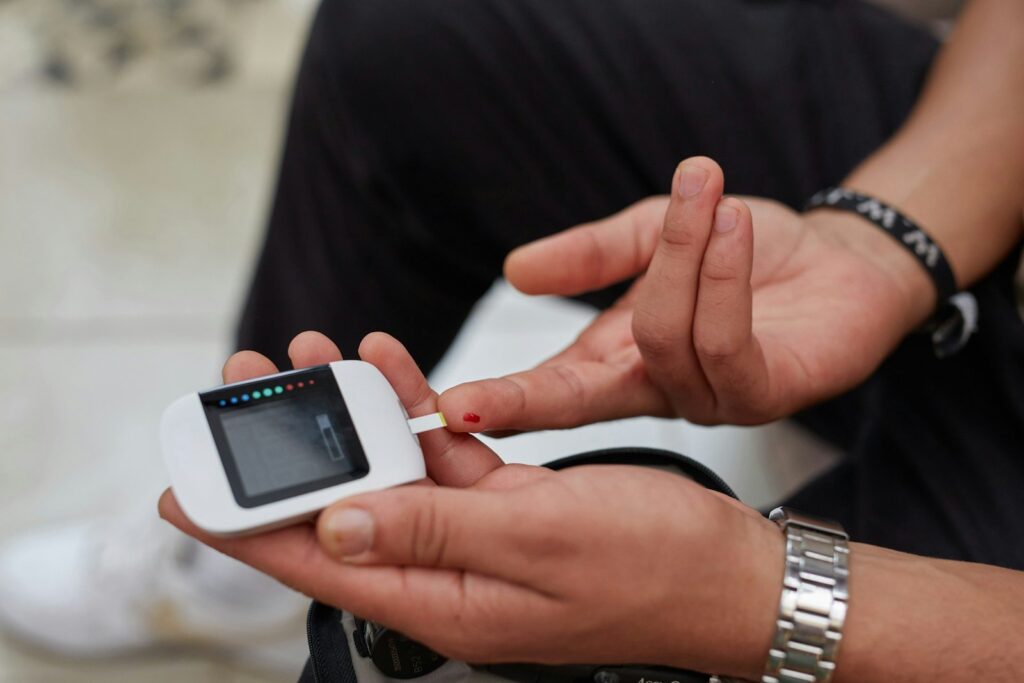
Fasting insulin has become a favourite marker in metabolic-health circles because it seems to promise an earlier warning than glucose. The idea is plausible: insulin can rise for years whilst fasting glucose still looks normal. The harder question is whether one fasting insulin result tells an individual what to do next. Usually, it does less than the marketing suggests.
What the test is trying to capture
Insulin is the hormone that helps move glucose out of the bloodstream and into tissues that can use or store it. When muscle, liver, and fat tissue become less responsive to insulin, the pancreas often compensates by releasing more. For a time, that compensation can keep fasting glucose in the normal range. This is why insulin resistance can be metabolically important before it becomes obvious on a standard glucose test.
The physiology is not controversial. NIDDK guidance on insulin resistance and prediabetes notes that insulin resistance and prediabetes often have no symptoms, which is part of the reason people can move through this phase unnoticed. A normal morning glucose value is useful information. It is not a complete map of insulin dynamics.
That is the legitimate appeal of fasting insulin. It asks whether the body is maintaining normal glucose at the cost of higher insulin output. The problem is that the answer depends on the assay, the population, the person’s recent behaviour, and what threshold is being used. There is no single universal cut-off that turns fasting insulin into a diagnosis.
Fasting insulin is a signal, not a disease label
A high fasting insulin result can be consistent with insulin resistance, especially when it travels with a larger waist circumference, higher triglycerides, low HDL cholesterol, raised blood pressure, fatty liver, or rising HbA1c. But it does not prove the same thing in every person. Someone may have temporarily higher insulin after poor sleep, acute stress, weight gain, reduced activity, or a recent shift in diet.
That context matters because insulin resistance is not a single organ problem. Liver insulin resistance can show up differently from skeletal-muscle insulin resistance. Fat-tissue insulin resistance adds another layer. Fasting insulin is a morning snapshot, not a dynamic stress test. It cannot show how quickly insulin rises after a meal, how fast glucose clears, or whether the pancreas is beginning to fail under demand.
What we have is a useful metabolic clue. What we do not have is a clean clinical category equivalent to blood pressure or LDL cholesterol, where widely agreed thresholds lead directly to treatment pathways. That distinction is where much of the confusion starts.
Where HOMA-IR fits in
HOMA-IR, short for homeostatic model assessment of insulin resistance, combines fasting glucose and fasting insulin into a calculated estimate. It is commonly used in research because it is cheap, simple, and far easier than clamp studies, which are the laboratory gold standard for measuring insulin sensitivity. In practice, it is often presented as if the calculation makes the result more clinical than fasting insulin alone.
The calculation is useful, but it has boundaries. Endotext’s chapter on assessing insulin sensitivity and resistance describes a range of methods, from invasive laboratory techniques to fasting-sample estimates, and stresses that interpretation depends on matching the method to the question being asked. HOMA-IR is best understood as an estimate under fasting conditions, not a full-body assessment of how someone handles food, exercise, or medication.
It also reflects the relationship between insulin and glucose at a single point in time. If fasting glucose is still normal but insulin is high, HOMA-IR may look elevated. If insulin production is already failing, a person can have worsening glucose with insulin that no longer looks dramatically high. The number needs physiology around it.
Why normal glucose can be misleading
The wellness version of fasting insulin testing often overstates the case, but it is right about one thing: glucose can be late. In the early stages of insulin resistance, the pancreas may simply work harder. Fasting glucose and HbA1c can remain acceptable until that compensation is no longer enough, or until post-meal glucose excursions become large enough to change the average.
That is why the most useful interpretation is comparative rather than absolute. A fasting insulin result is more meaningful when viewed alongside fasting glucose, HbA1c, triglycerides, HDL cholesterol, liver enzymes, blood pressure, waist measurement, family history, sleep, medications, and recent weight change. One marker rarely carries the argument by itself. Several markers moving in the same direction deserve attention.
There is also a behavioural trap. A person can turn fasting insulin into a scoreboard and chase tiny changes whilst ignoring the larger drivers of metabolic risk. The goal is not to achieve a perfect insulin number. The goal is to reduce the underlying metabolic strain that the number may be hinting at.
The evidence links insulin resistance to risk
Insulin resistance is not merely a laboratory curiosity. It sits upstream of type 2 diabetes for many people and tends to cluster with cardiovascular risk factors. The question is not whether the biology matters. It is whether fasting insulin testing improves decisions beyond the tools clinicians already use.
Research supports the risk signal, but with the usual limits of population data. A meta-analysis on fasting insulin, HOMA-IR, and cardiovascular outcomes found that HOMA-IR showed the clearer association with all-cause mortality in adults without diabetes. Fasting insulin alone was weaker in the authors’ analysis, and cardiovascular-mortality evidence was limited by the small number of included studies. Association is not destiny, and it does not prove that testing fasting insulin changes outcomes. It does suggest that the marker is pointing at something metabolically relevant.
For an individual, that means the result should sharpen the next conversation rather than end it. If fasting insulin is high and other metabolic markers are worsening, the practical response is rarely exotic: improve body composition if needed, build muscle, increase physical activity, reduce energy excess, improve sleep, and treat blood pressure or lipids when indicated. Those are not glamorous interventions. They are the ones most consistently tied to better metabolic outcomes.
When testing may be reasonable
Fasting insulin or HOMA-IR may be worth discussing when standard markers look borderline but the wider picture suggests higher metabolic risk. Central weight gain, a strong family history of type 2 diabetes, polycystic ovary syndrome, fatty liver, high triglycerides, low HDL cholesterol, or deteriorating post-meal glucose patterns can all make the question more relevant. That does not mean the test is required; it means the result may add context if a clinician agrees it would change the follow-up plan.
The test is less useful as a one-off curiosity in an otherwise low-risk person. It is also less useful when the result will not change behaviour, medication discussion, or follow-up. A lab result should earn its place by changing the decision space. If it only creates anxiety or number chasing, it has failed the test of clinical usefulness.
If the test is repeated, the interval should be long enough to reflect a real change in behaviour, weight, medication, sleep, or training. Checking every few weeks is more likely to create noise than insight. The result is most useful when it is read as part of a broader trend, alongside weight, waist, glucose, HbA1c, lipids, blood pressure, and the actual intervention being tested.
What this means in practice
- Treat fasting insulin as a metabolic signal, not a stand-alone diagnosis of insulin resistance.
- Interpret it with fasting glucose, HbA1c, triglycerides, HDL cholesterol, blood pressure, waist measurement, and family history.
- Use HOMA-IR as an estimate, not as a precise measure of whole-body insulin sensitivity.
- If the number is high, focus first on muscle-building activity, daily movement, sleep consistency, and reducing sustained energy excess.
- Do not re-test too frequently; look for trends over months, not small week-to-week changes.
- Discuss abnormal results with a clinician, especially if glucose, HbA1c, blood pressure, liver enzymes, or lipids are also moving the wrong way.
What we don’t know
We do not yet know whether routine fasting insulin testing in generally healthy adults improves hard outcomes such as diabetes prevention, cardiovascular events, or mortality. The marker is biologically plausible and often useful in research, but clinical utility requires more than plausibility. It requires evidence that measuring it changes decisions in a way that improves outcomes.
We also lack universal thresholds. Different laboratories use different insulin assays, and HOMA-IR cut-offs vary by population, age, ethnicity, body composition, and study design. A number that looks elevated in one reference set may be less clear in another. This is why fasting insulin should be read as part of a pattern, not treated as a verdict.
The conservative position is still useful. Fasting insulin can reveal metabolic strain before glucose crosses a diagnostic line. It cannot tell you everything about insulin resistance, and it should not be sold as an early-warning crystal ball. Used carefully, it is a prompt to look harder at the system. Used carelessly, it is just another number to worry about.
Photo: Sweet Life on Unsplash.