Lion’s mane is sold as a brain supplement, but the honest case is narrower. A few small human studies suggest possible effects on cognition, stress, or mood. They do not prove dementia prevention, and they do not make every capsule equivalent. With this mushroom, the useful question is not whether the name is fashionable. It is what, exactly, is in the product.
The mushroom is not the same as the supplement
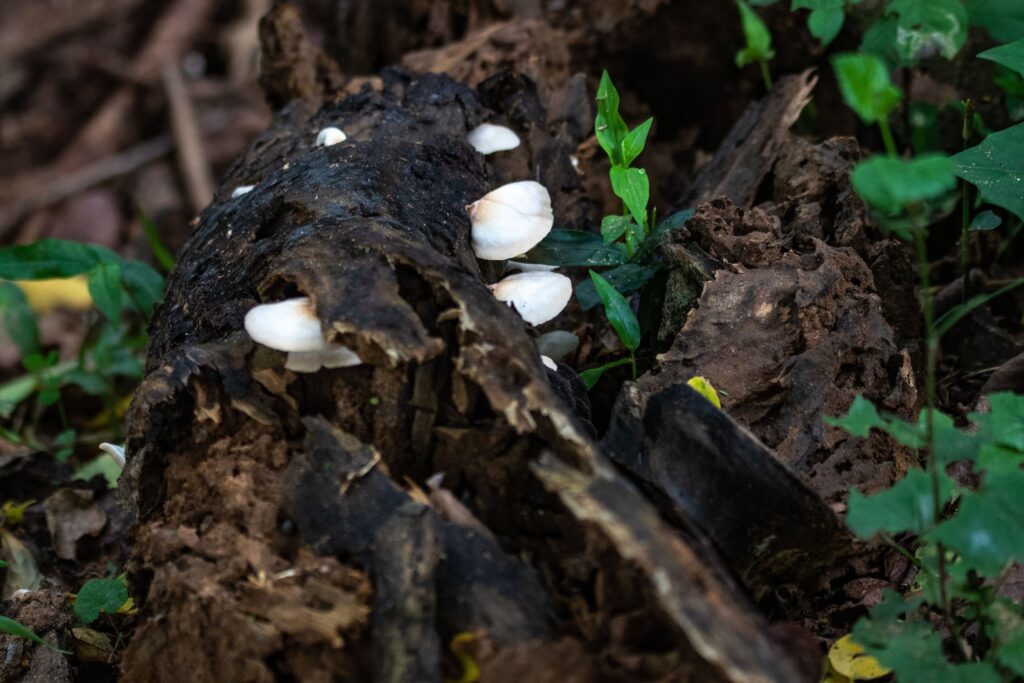
Lion’s mane, or Hericium erinaceus, is an edible mushroom with long white spines. In supplement form it appears as powders, capsules, tinctures, coffees, and blends. Those products may use the fruiting body, the mycelium, an extract, a dried powder, or a mixture. That distinction matters because the compounds usually discussed in lion’s mane research are not spread evenly across all preparations.
Hericenones are often associated with the fruiting body, whilst erinacines are usually discussed in relation to mycelium. Both groups have been studied for effects on nerve-growth-factor signalling, mostly in cells and animals. That mechanism is interesting. It is not the same as proving that a shop-bought supplement improves memory in a meaningful human way.
This is where the supplement market becomes untidy. A label that says “lion’s mane” may not tell you whether the product contains fruiting body, mycelium, grain substrate, a standardised extract, or a simple dried powder. Two products can share the same front label and deliver quite different material.
What the cognitive studies actually show
The human evidence is small, mixed, and still worth reading. In a randomised, double-blind pilot study of 41 healthy young adults, participants took 1.8 g of Hericium erinaceus for 28 days. The researchers reported faster Stroop-task performance after a single dose and a trend towards lower subjective stress after chronic supplementation. They also reported null and limited negative findings, and they explicitly called for larger studies.
Older work is often cited more confidently than it deserves. In a Japanese double-blind trial of 30 adults aged 50 to 80 with mild cognitive impairment, the active group took 3 g daily of powdered Yamabushitake for 16 weeks. Cognitive-function scores improved during treatment, then fell four weeks after supplementation stopped. That is a signal, not a clinical treatment pathway.
A more cautious reading is supported by Memorial Sloan Kettering Cancer Center’s clinical summary, which describes limited clinical data for memory and mood and notes that some uses have not been studied in humans. The pattern is familiar in supplement science: promising mechanisms, small trials, enthusiastic marketing, and not enough independent replication.
It also matters who is being studied. A trial in healthy adults measuring task speed is not interchangeable with a trial in older adults with mild cognitive impairment, and neither tells us much about people with diagnosed dementia, attention disorders, depression, or chemotherapy-related cognitive symptoms. Supplement marketing often collapses those populations into one phrase: brain health. Clinical research does not work that way.
The dose question is less settled than labels imply
Lion’s mane products commonly list 500 mg, 1,000 mg, or 2,000 mg per serving. That number is less informative than it looks unless the label also states the form. One gram of dried mushroom powder is not the same as one gram of extract. A dual extract is not the same as hot-water extract. Mycelium grown on grain is not the same as fruiting body harvested as mushroom tissue.
The small human studies also used different protocols: 1.8 g daily in young adults for 28 days, 3 g daily in the older mild-cognitive-impairment trial, and other newer studies using standardised fruiting-body extracts. That does not give consumers a clean dose target. It gives a range of experimental choices, each tied to a particular preparation.
This is the central issue for any cautious reading of lion’s mane. The compound story may be plausible, but the product story is unresolved. If a brand does not state the mushroom part used, extraction method, beta-glucan content, and contaminant testing, the dose on the front panel is mostly decoration.
Safety looks reassuring, but not empty
Lion’s mane is a food mushroom, and that gives it a better starting point than many supplement ingredients. Still, a concentrated supplement is not lunch. LiverTox, from the US National Institute of Diabetes and Digestive and Kidney Diseases, describes lion’s mane as generally recognised as safe and says it has not been linked to clinically apparent liver injury in typical use. It also notes that short-term human studies have reported few adverse events.
The adverse effects that do appear are usually mild: abdominal discomfort, nausea, diarrhoea, headache, or rash. Memorial Sloan Kettering also advises people to tell healthcare providers about supplements, partly because herbal products can interact with medicines or complicate care.
That advice is especially relevant for people who are pregnant, immunocompromised, managing cancer treatment, taking complex medication, or reacting to mushrooms. The point is not that lion’s mane is especially dangerous. The point is that “natural” is not a safety category, and mushroom supplements are often sold with more certainty than the evidence can carry.
Product testing is the practical dividing line
Quality control matters because mushroom supplements sit in a category where identity, extraction, and contamination are real variables. A 2021 analysis of cadmium and lead in selected fungi states the basic food-safety problem clearly: mushrooms can accumulate toxic trace elements from their environment. A 2020 study of mushroom-derived food supplements in the Journal of the Serbian Chemical Society found considerable differences in beta-glucan and polyphenol content across products, linked to mushroom species, forms, and dosing regimens. That does not mean every lion’s mane product is contaminated or weak. It means the growing source and batch testing are not cosmetic details.
The better label is specific. It says fruiting body, mycelium, or both. It gives an extraction method. It lists meaningful markers such as beta-glucans, not only broad mushroom-polysaccharide language. A USP-linked analysis of 19 reishi mushroom supplements sold in the United States found that only five matched their labelled ingredients when tested for bioactive components, which is not lion’s mane proof but is a useful warning about mushroom-supplement quality control. The wider regulatory logic is similar: FDA dietary-supplement manufacturing guidance defines quality around specifications for identity, purity, strength, composition, and contaminant limits, and says manufacturers must verify dietary-ingredient identity using an appropriate test or examination. Batch-level third-party testing for identity and common contaminants makes the product easier to assess.
There is another practical question: what else is in the capsule. Many “mushroom focus” products combine lion’s mane with caffeine, rhodiola, bacopa, ginkgo, or B vitamins. If a user feels more alert, the active ingredient may not be the mushroom. Combined formulas also make side effects harder to interpret. A single-ingredient product is easier to assess and easier to stop cleanly.
This does not make the product proven. It only makes the product legible. Without that, a lion’s mane supplement is difficult to evaluate even before anyone asks whether it works.
What this means in practice
- Treat lion’s mane as a speculative cognitive supplement, not a dementia-prevention plan.
- Look for labels that state fruiting body, mycelium, extraction method, and standardised markers.
- Be sceptical of products that claim “nerve growth factor support” without human outcome data.
- Prefer brands that publish batch-level third-party testing for identity and contaminants.
- Stop if you develop rash, digestive symptoms, headache, or any allergic-type reaction.
- Discuss use with a clinician if you have cancer, immune problems, pregnancy, complex medicines, or neurological symptoms.
What we don’t know
We do not know whether lion’s mane prevents dementia, slows age-related cognitive decline, or meaningfully improves cognition in healthy adults over the long term. We do not know the best form, dose, duration, or marker profile. We also do not know whether benefits seen in one extract translate to another product with the same common name.
A 2025 systematic review on Hericium erinaceus supplementation summarised promising findings across neuroprotection, cognition, mood, and gut-health pathways. But much of this literature includes preclinical work, small human studies, mixed preparations, and endpoints that are not yet clinical decision tools. That is a research agenda, not a reason to replace medical assessment.
The conservative conclusion is simple. Lion’s mane has enough human evidence to be interesting, and not enough to be treated as a brain-health drug. If someone tries it, the product’s identity and testing matter almost as much as the mushroom itself.
Photo: Magda Ehlers on Pexels