Cranberry supplements occupy an awkward space between food and preventive medicine. There is credible evidence that some products reduce repeat urinary tract infections in some women. That does not establish which capsule to buy, and it does not make cranberry a treatment for an infection already under way. The useful question is narrower: who might benefit, from which preparation, and with what uncertainty?
Prevention is the claim worth examining
The distinction matters before any discussion of capsules. A product studied over months to reduce future infections has not thereby been shown to clear bacteria or relieve a current episode. The US National Institute of Diabetes and Digestive and Kidney Diseases states that cranberry juice, extracts, and pills do not treat existing bladder infections. Its assessment of prevention remains cautious: some research suggests benefit, but uncertainty persists.
That is a more useful starting point than the phrase “urinary health” on a label. The phrase does not tell a reader whether the manufacturer means fewer infections, less discomfort, or a change in a laboratory measurement. Those are separate outcomes. A meaningful prevention claim should identify the people studied, the preparation used, and the infections counted.
For someone with repeated episodes, the first conversation is therefore about what has been happening and how a clinician has assessed it. A supplement decision belongs within that conversation. It cannot establish the diagnosis or supply a plan for the next acute episode.
The evidence supports a limited benefit
Gabrielle Williams and colleagues’ 2023 Cochrane review included 50 randomised trials involving 8,857 participants. In women with recurrent UTIs, eight trials involving 1,555 participants suggested fewer symptomatic, culture-confirmed infections with cranberry. The pooled risk ratio was 0.74, with a 95% confidence interval of 0.55 to 0.99; the reviewers judged this moderate-certainty evidence.
That corresponds to an estimated 26% relative reduction, rather than 26 fewer infections for every 100 people. As a purely illustrative calculation, if 20 in 100 people would otherwise have an infection over a particular period, a risk ratio of 0.74 would imply about 15 in 100. The actual absolute benefit depends on the starting risk and follow-up period.
The population boundary matters. The review found little or no benefit in older people living in institutions, pregnant women, or adults with bladder-emptying problems associated with neuromuscular dysfunction. Findings in one group should not be repackaged as protection for everyone who worries about UTIs.
The dose on the bottle may answer the wrong question
The proposed active components include proanthocyanidins, usually shortened to PACs. A label reporting milligrams of cranberry extract is not reporting the same thing as milligrams of PACs. The distinction becomes obvious in the preparation details in the Cochrane review: reported PAC quantities varied substantially, and many studies did not quantify them.
Among tablet, capsule, and powder studies that estimated PAC content, reported doses ranged from 1.4 to 120 mg a day. Juice studies used different volumes and ways of describing concentration. The reviewers identified the absence of a standardised PAC dose as a limitation. A larger extract number on a package therefore cannot be read as evidence of greater protection.
This is the product question that supplement marketing often leaves unanswered. What exactly was measured? Is the daily amount expressed as extract weight or PAC content? Does the preparation resemble one evaluated in a clinical trial? A label can provide useful information without proving that the product reproduces a trial’s result.
Why 36 mg is not a settled prescription
A 2024 review by Zheyu Xiong and colleagues in Frontiers in Nutrition pooled ten randomised trials that reported PAC intake. In trials providing at least 36 mg daily, the pooled risk ratio was 0.82, suggesting an 18% relative reduction. Below that level, the pooled result was not statistically significant.
This is a dose signal worth investigating. It does not establish a universal minimum effective dose. Separating trials by dose also separates studies that can differ in participants, preparations, and methods. A statistically significant result in one subgroup and a non-significant result in another does not, by itself, prove that the subgroups differ.
The authors also discuss differences in methods used to measure PACs. That complicates apparently straightforward comparisons between packages. These results are a reason to ask better questions about a product, rather than instructions to select a particular number and begin a regimen. They also do not settle the comparison between juice and capsules.
A direct trial shows why restraint is needed
In Asma Babar and colleagues’ 2021 trial in BMC Urology, 145 adult women with recurrent UTIs received standardised cranberry PAC extract for 24 weeks. The higher-dose group received 18.5 mg twice daily, totalling 37 mg; the comparison group received 1 mg twice daily.
The higher dose produced a non-significant reduction in symptomatic infections overall: the incidence rate ratio was 0.76, with a 95% confidence interval of 0.51 to 1.11. That interval includes no difference. A favourable finding emerged in a subgroup examined after the main analysis, but such findings need confirmation.
The comparison was with a low dose, rather than an inactive placebo. Two authors were employees of a cranberry-ingredient company, a disclosed interest that readers should know. Neither point invalidates the trial. Together with the uncertain primary result, they show why one study cannot provide a shopping instruction. These are research doses and forms, not a personal recommendation.
Safety and medical context still count
The NIH’s cranberry safety assessment describes oral cranberry as generally thought to be safe, whilst noting stomach upset and diarrhoea with very large amounts. It also describes conflicting evidence about an interaction with warfarin. Anyone taking warfarin should discuss cranberry with their prescriber or anticoagulation service before using it; uncertainty about an interaction is not reassurance that it cannot occur.
Pregnancy and breastfeeding require a separate discussion. Evidence about quantities normally eaten as food does not establish the safety of larger supplemental amounts. The NIH advises consulting a healthcare professional. Children should not be given an adult supplement regimen by extrapolation.
NICE’s recurrent-UTI guidance describes cranberry’s benefit as uncertain, highlights the sugar content of products, and says use in under-16s should follow paediatric specialist advice. Its cranberry recommendations date from 2018, before the larger 2023 Cochrane update. That timing helps explain the different emphasis without removing the remaining uncertainty. NICE also sets out clinician-led preventive options; cranberry should not displace a review of those options.
What this means in practice
- For recurrent episodes, bring a record of symptoms, test results, and previous treatments to a clinical review. Discuss whether prevention is appropriate before choosing a supplement.
- If discussing a cranberry product, bring the full label. Identify its form, daily serving, extract amount, stated PAC content, and sugar content. Treat missing information as a limitation.
- Include supplements in your medicines list, especially when taking warfarin. Ask the prescriber or pharmacist to check suitability rather than assuming a food-derived product cannot interact.
- Agree how a possible preventive approach would be reviewed and what to do if symptoms return. Do not use cranberry to postpone assessment or replace prescribed treatment.
- Seek urgent GP or NHS 111 advice for suspected UTI with fever or shivering, pain in the back under the ribs, blood in urine, or rapid worsening. Pregnancy and age 65 or over also warrant urgent advice. Call 999 for confusion, drowsiness, or difficulty speaking, as the NHS UTI guidance advises.
What we don’t know
We still lack a dependable way to translate the research into one preferred retail preparation, PAC dose, and duration for every person with recurrent UTIs. Evidence about prevention also leaves the question of treating an established infection unanswered. These are different clinical jobs.
The tension between a positive pooled result, uncertain dose comparisons, and a cautious guideline should remain visible. A reasonable editorial conclusion is that cranberry merits a discussion for some people with recurrent UTIs, with expectations tied to the population and product studied. It does not merit a blanket recommendation for older adults or a promise of antibiotic-free care.
The compound has a plausible preventive role. The product on the shelf still needs scrutiny, and an infection that has already started needs its own clinical assessment.
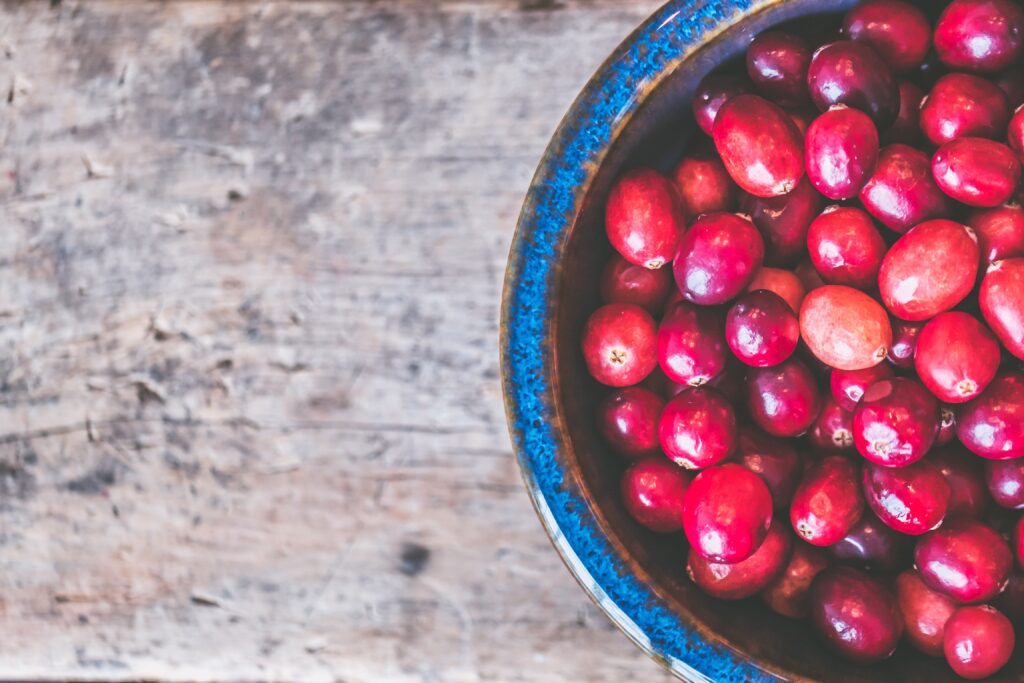
Photo: Jessica Lewis on Pexels. Illustrative food photograph; not the preparation used in the trials.