Tai chi has acquired an almost suspicious reputation in ageing science: slow, graceful, low-tech, and still surprisingly hard to dismiss. For older adults worried about balance, the evidence is useful but not magical. Tai chi can reduce falls in some groups, especially when taught as a structured balance programme, but it is not a charm against every trip, medicine side-effect, or icy pavement.
Why slow movement can still be demanding
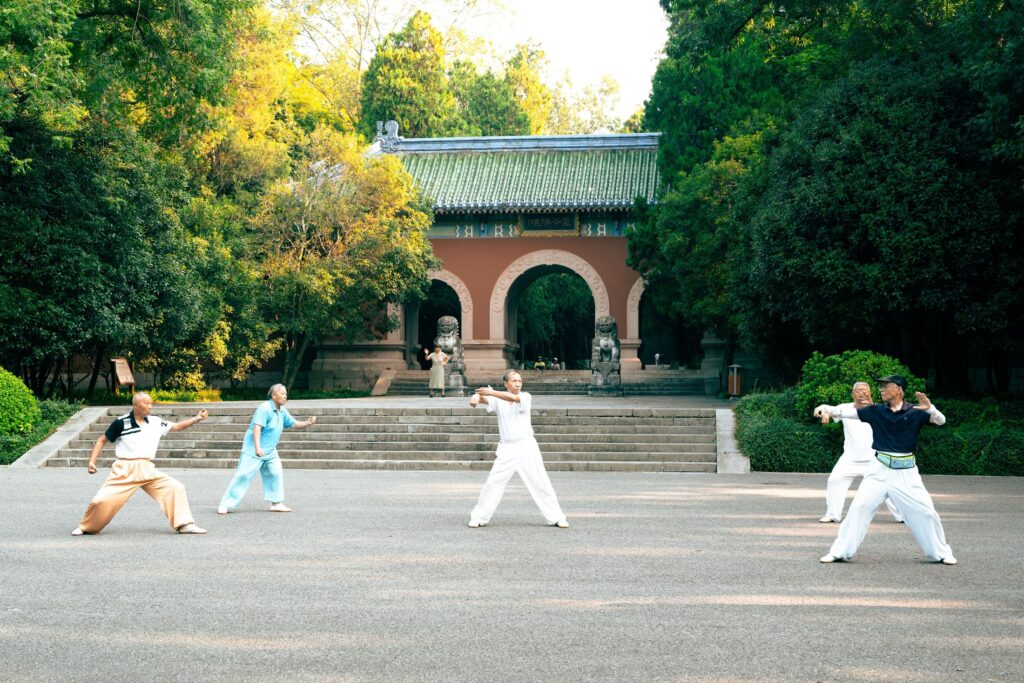
Tai chi looks gentle from the outside. That is partly the point. The work is not in speed or strain, but in repeated weight shifts, controlled single-leg moments, trunk rotation, and attention to where the body is in space. Those are the same ingredients people need when they step off a kerb, turn in a narrow kitchen, or recover from a small stumble.
The distinction matters because balance is not one skill. Static balance, dynamic balance, leg strength, reaction time, vision, sensation in the feet, medication burden, and confidence all contribute to fall risk. A practice that asks someone to move slowly while staying upright may train several of those pieces at once. It will not train all of them equally, and it will not remove every external hazard.
That is why the slowness should not be mistaken for ease. Many forms require the practitioner to pause with one foot lightly loaded, rotate through the hips without rushing, and place the next step accurately before committing weight. In a younger athlete, that might look like a warm-up. In an older adult with stiff ankles, weaker hip muscles, or a recent scare on the stairs, it can be a genuine training stimulus.
What the trials show
The strongest case for tai chi comes from trials in older adults at higher risk of falling. In a 2018 randomised clinical trial in JAMA Internal Medicine, 670 community-dwelling adults aged 70 and older, all with a recent fall or impaired mobility, were assigned to therapeutic tai ji quan, multimodal exercise, or stretching. Over six months, the tai ji quan group had fewer falls than the stretching group and fewer falls than the multimodal exercise group.
A follow-up analysis in JAMA Network Open looked specifically at injurious falls in the same trial population. The tai ji quan intervention lowered moderate injurious falls compared with stretching and lowered serious injurious falls compared with both stretching and multimodal exercise. That is a meaningful result, but it applies most directly to a supervised, therapeutic version of tai ji quan, not to any casual class with the same name.
Reviews point in the same direction, with the usual caveats. A 2017 systematic review and meta-analysis concluded that tai chi reduced falls in older adults, with greater effects in programmes done more frequently. A later 2023 review on fall prevention and balance also found benefits for fall prevention and balance, whilst noting differences across styles, doses, and participant risk levels.
The dose is not an afterthought
The practical detail people often miss is frequency. In several positive trials, tai chi was not an occasional wellness class. It was taught repeatedly, often two or three times a week, over months. That does not mean every older adult needs a formal therapeutic programme forever. It does mean that one gentle session every other week is unlikely to reproduce the results seen in trials.
This is where tai chi resembles strength training more than relaxation. The body adapts to repeated practice. A movement that feels awkward in week one becomes steadier in week eight because the nervous system, muscles, joints, and attention have had time to rehearse it. The benefit is less likely to come from any single named form than from repeated, progressive exposure to controlled balance challenges.
A good class also has progression, even if nobody uses that word. The stance may become a little deeper. The turns may become more confident. The instructor may ask for a slower transition, a smaller base of support, or a longer hold before the next step. Those changes are not decoration. They are how a balance practice keeps asking the body to adapt without turning into a boot camp.
How it compares with ordinary exercise
Tai chi is not the only useful option. The 2024 US Preventive Services Task Force recommendation supports exercise interventions for community-dwelling adults aged 65 and older who are at increased risk of falls. The recommendation is not tai chi-specific; it includes structured exercise approaches that address balance, gait, and physical function.
That broader framing is important. A well-run strength and balance class may be a better fit for one person. Physiotherapy may be the right first step for someone with neurological symptoms, repeated falls, or fear that keeps them from leaving the house. Tai chi is attractive because it is low impact, scalable, and social, but those advantages do not make it automatically superior to every other exercise programme.
The comparison should be practical, not ideological. If someone will attend tai chi twice a week and abandon the gym after two visits, tai chi is the stronger intervention for that person. If another person needs leg strength after illness or surgery, a resistance programme may be more direct. The right question is not whether tai chi is ancient or modern. It is whether the class trains the balance problem the person actually has.
Who may benefit most
The best candidate is not necessarily the fittest person in the room. Tai chi may be especially useful for someone who can stand and walk independently but notices poorer confidence when turning, stepping sideways, or moving in crowded places. It may also suit people who dislike gym settings or cannot tolerate higher-impact exercise.
People at very high risk need more caution. A person who has fallen repeatedly, blacks out, has new leg weakness, or feels dizzy on standing should not treat tai chi as the first and only answer. Those signs deserve medical review. Medication effects, blood-pressure drops, vision problems, neuropathy, and home hazards can all drive falls, and tai chi will not fix them by itself.
There is also a confidence question. After a fall, some people move less because they are afraid of falling again. Less movement can then mean weaker legs, slower reactions, and even more caution. A calm class that lets someone practise controlled movement in company may help interrupt that loop. It is not psychotherapy, and it is not a guarantee, but it can be a tolerable way back into moving deliberately.
What this means in practice
- Choose a class that teaches older adults or beginners, not a performance-focused martial arts class.
- Start near a wall, chair, rail, or instructor until the turns and weight shifts feel predictable.
- Practise at least twice a week for several months before judging whether it helps.
- Keep strength work in the week as well; tai chi is not a full substitute for progressive resistance training.
- If you have fallen recently, ask a clinician or physiotherapist whether you need a broader falls assessment.
What we don’t know
We do not know the perfect tai chi prescription for every older adult. Trials vary by style, instructor training, class frequency, session length, baseline fall risk, and what the comparison group receives. Some studies use therapeutic tai ji quan programmes designed for fall prevention, while community classes may be looser and less progressive.
We also do not know how well benefits persist when classes stop. That is a familiar problem in exercise research. The most sensible assumption is that balance, like strength, needs maintenance. If tai chi helps, it probably helps because it becomes a regular practice rather than a short course completed once.
Tai chi deserves its place in the fall-prevention conversation. The evidence is strong enough to take seriously and modest enough to keep in proportion. For many older adults, the best version is simple: a good teacher, steady attendance, a safe practice space, and the patience to let slow movement become useful movement.
Photo: Cheng Shi Song on Pexels.