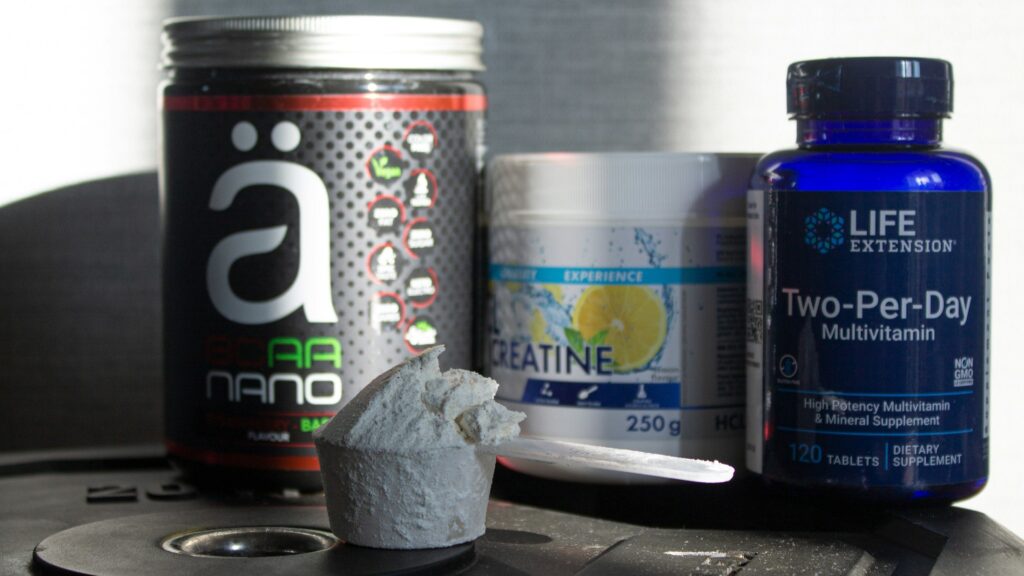
Creatine keeps coming back as the supplement with the strongest claim-to-usage gap in longevity media. It is sold as a brain tonic, a metabolic reset, and sometimes a prevention strategy for every age-related decline. That framing overstates the evidence. The strongest claim the field can defend is this: in short, high-intensity training contexts, creatine monohydrate can improve exercise performance and functional outcomes, especially when the goal is maintaining strength and body composition with age.
Why this supplement keeps being overpromised
Creatine is a compound your body synthesises and stores mainly in skeletal muscle, where it helps rapidly regenerate ATP through the phosphocreatine system. For an ageing audience, that matters because higher-intensity efforts become harder with lower energy turnover and reduced training volume. In practical terms, people who are trying to keep strength, gait confidence, and balance function are more likely to value performance outputs than biochemical “numbers” alone.
What drives the hype cycle is a simple asymmetry. Positive trial effects tend to be clean and concrete for athletic tasks — repetitions, load progression, or force output — while the headlines extrapolate those outcomes to far broader clinical claims. As with many supplements, the compound can be useful without being universal medicine.
What the evidence stack can actually support
The NIH Office of Dietary Supplements’ exercise performance clinical review still reflects the core signal: creatine helps with repeated bursts of high-intensity effort and is used as a performance support in resistance work, while evidence is much less convincing for endurance outcomes or as a stand-alone health fix.Ongoing ODS review guidance also places emphasis on pairing supplements with training adaptations, not replacing them.
The age-related use case has become more relevant as trials move into older cohorts. A recent synthesis in PubMed reports that doses around 5 g/day with resistance training improved lean mass and strength in post-menopausal women, while effects on bone density and longer outcomes remain less clear. In older populations, gains are typically modest, and protocol quality varies; the signal is real but not as broad as marketing copy suggests.
That distinction matters because mechanistic plausibility is not the same as clinical proof. In other words, a pathway can be biologically coherent and still fail the harder test of durable, generalisable benefit. The field has exactly that pattern: promising biology, variable hard outcomes.
Creatine and function: what it does, and when it does not
From a practical perspective, the outcome patients and readers can feel is not “less ageing,” it is usually a change in capacity to train:
- better tolerance for progressive resistance sessions,
- slightly higher force or repetition targets in structured programmes,
- improved confidence to sustain regular movement habits.
If you are using creatine only for longevity branding, that is where the evidence is weakest. If you are using it to support a strength routine, preserve mobility, or make physical rehabilitation less mentally expensive, the signal is more credible.
Dose, form, and what we still get wrong at the checkout
Mechanism talk is not enough. The compound form and dose matter. The ODS guidance for sport-oriented use still uses creatine monohydrate as the best-studied form, and often cites loading strategies in the range of around 20 g/day for roughly one week, then 3–5 g/day maintenance for ongoing use.ODS supplement fact sheet text This is not a call to cycle, stack, or stack with a protocol stack.
What does go wrong in real life is product variance. Under the hood, “creatine” can vary by purity, labelling accuracy, and dose uniformity. You can have a capsule labelled 3 g and consume much less active content per cap. You can also have contamination risk and under-labelled filler profiles, which is where product-grade controls matter more than clever timing.
A practical quality gate for readers is simple: choose independent-tested products with explicit third-party analysis for contaminants and actual creatine content, and keep an eye on lot-to-lot consistency. A shelf with a glossy name does not replace analytical evidence.
Safety and caveats: where the risk profile is less forgiving
In healthy adults, severe harm is uncommon in standard use, but the risk is not zero. A large meta-analytic safety review examined kidney-function markers and did not find a universal signal of major harm, yet flagged uncertainty in people with existing renal risk and the need for clinical caution.PubMed kidney-function meta-analysis Side effects can still include GI upset, fluid shifts, and weight changes; those are not catastrophic for everyone, but they can disrupt adherence.
Importantly, for people already managing kidney disease, taking prescription drugs affecting renal clearance, or combining many concentrated supplements, a clinician review should come first. The mistake is not in taking creatine itself; the mistake is assuming “natural” means neutral in every context.
The cognitive claim problem
Longevity writing often folds muscle and cognition into one claim. The UK scientific-health-claims review route is instructive here: where evidence was submitted for cognitive improvement, no clear cause-and-effect relationship was accepted for low to moderate doses.UKNHCC assessment of creatine cognitive claims In plain language: there may be plausible mechanisms, but the confidence for broad cognitive translation is not where the sales decks want it to be.
That does not make the supplement invalid for strength goals; it means claims should be lane-appropriate. If your endpoint is memory enhancement, this is not the same evidence base as an endpoint of training adaptation.
What this means in practice
- Use creatine only if you are training with progressive resistance at least two to three times weekly.
- Choose monohydrate, and dose consistently rather than cycling randomly through products.
- Track objective markers: load, repetitions, and pain-free training consistency over 8–12 weeks.
- If you have kidney disease or complex medication plans, clear it with a clinician first.
- Ignore “brain,” “anti-ageing,” and “metabolic reset” claims that are not backed by comparable outcome-level data.
What we don’t know
What remains uncertain is not whether creatine has a biochemical role in energy metabolism — that is largely settled — but how large and durable the real-world functional upside is across diverse older adults outside trials. We do not yet have high-confidence, long-horizon evidence for reduced hospitalisation, reduced mortality, or a broad disease-modifying claim in healthy populations. We also do not have complete certainty about quality differences across global supply chains.
The strongest position remains restrained: creatine can be useful where the question is functional performance support, not disease reversal. The science is clearer for that narrower question than for the broad narrative that every supplement with a plausible mechanism improves ageing by default.
Creatine is neither a fake nor a panacea. It can be a useful tool in a strength-preserving programme, and the best evidence is strongest when the protocol is disciplined: known form, measured dose, training context, and realistic expectations. Treating it as a longevity shortcut is the exact mistake the evidence repeatedly asks us to avoid.
For supplements to be clinically honest in a home setting, the test needs to be behavioural as much as biochemical. Pick one training block, baseline your key numbers, and hold everything else fixed for 8 to 12 weeks. If load progression and weekly consistency do not improve, pause and reassess before adding additional products.
Useful anchors are low-effort and unglamorous: session compliance, repetition quality, and simple functional outcomes like sit-to-stand comfort or stair climbing reliability. In people who value function over appearance, these outcomes matter more than laboratory noise. They also make the intervention falsifiable. A product that does not produce measurable behavioural gains is rarely worth the ongoing cost or habit load.