After a fall, returning to exercise can feel like a question of courage. The research suggests a more useful question: what support would make movement safer? Structured strength and balance work can reduce subsequent falls in some older adults. But recovery also involves checking injuries, understanding what caused the fall, and addressing the fear that can make everyday activity shrink.
First, establish what happened
The first decision after a fall concerns care, rather than training. NHS guidance on falls advises calling 999 if someone cannot get up or may have injured their head, back, neck, or hip. Pain, injury, or feeling unwell after a fall warrants help from NHS 111. An exercise article cannot establish whether it is safe to put weight through an injured limb.
Once immediate needs have been addressed, a fall still deserves a conversation with a healthcare professional. The NHS recommends seeing a GP after a fall or for concerns about balance or mobility. Being able to walk afterwards does not answer every question about why it happened.
For that conversation, a description is more useful than a verdict such as “I am getting old”. Where were you? Were you turning, reaching, or getting out of bed? Did you feel faint? What happened immediately afterwards? These are prompts for explaining the event, not a home diagnostic checklist.
Assessment can change the movement plan
NICE’s 2025 falls guideline covers everyone aged 65 and over, and adults aged 50–64 with additional risk factors. It recommends comprehensive assessment after a fall when there is frailty, injury needing medical treatment, associated loss of consciousness, inability to get up independently, or at least two falls in the past year.
A single fall without those features can still lead to assessment of walking and balance. The point is to distinguish someone who needs a broader investigation from someone who might benefit from a more focused exercise referral.
That assessment can include medicines, vision, blood pressure, and other contributors alongside movement. A physiotherapist’s exercise plan and a clinician’s investigation can therefore belong in the same recovery process. They answer different parts of the problem.
It is reasonable to ask the professional overseeing recovery: “What activity is suitable now, and what would make you want to reassess me?” The answer should be specific enough to use at home.
A trial tested exercise after a previous fall
In a 2019 randomised trial in JAMA, Teresa Liu-Ambrose and colleagues studied adults aged at least 70 who had attended a falls clinic. Participants received geriatrician-led care; the intervention group also received a physiotherapist-delivered home strength and balance programme.
Over roughly a year, the estimated fall rates were 1.4 falls per person-year with exercise and 2.1 with usual care. The relative fall-rate reduction was 36%. That is encouraging evidence for supported rehabilitation after a fall.
It does not mean that 36% of participants became protected against falling. A rate counts events, including repeated falls in the same person. It also does not mean an exercise sheet downloaded without assessment will reproduce the result. The intervention sat within clinical care.
For a reader, the useful question is therefore less “Which movement delivered the percentage?” and more “Can I access a programme with a comparable level of assessment and follow-up?”
Home exercise can still involve professional support
The broader evidence supports exercise, whilst keeping the type of training in view. A 2019 Cochrane review of community falls prevention found high-certainty evidence that exercise reduces falls. Balance and functional exercise featured prominently in effective programmes. Evidence for walking alone as a falls-prevention intervention was uncertain.
That makes “just go for a walk” an incomplete account of rehabilitation. Walking and a programme designed around turning, stepping, or getting up serve overlapping but different purposes. The review does not establish one universal routine for everyone who has fallen.
NICE recommends programmes delivered by appropriately trained professionals, tailored to the person’s abilities and goals, with progression and regular reviews. Home-based need not mean unsupported. Before leaving an appointment, it is worth clarifying who will check progress and how to contact them if the exercises no longer feel suitable.
A useful written plan should be understandable on an ordinary Tuesday, without the instructor standing beside you. Asking for clarification is part of using the programme well.
Fear deserves its own attention
Fear can become a problem in its own right. The Cochrane review’s explanation of fear of falling describes a lasting concern that leads people to avoid activities they remain capable of doing. The consequences may show up as abandoned shopping trips or visits, rather than a complaint about exercise.
A 2023 Cochrane review of cognitive behavioural therapy found that CBT, with or without exercise, probably reduces fear of falling after treatment. Evidence that it reduces actual falls was very uncertain. Feeling safer and falling less often are related questions, but they are not interchangeable outcomes.
This gives a reason to describe fear directly at an appointment. “I no longer go out alone because I am afraid of falling” communicates something that a strength measurement may miss. Support can then address the concern as well as physical ability.
Neither reassurance from family nor determination should be treated as a substitute for that discussion. The goal is a workable return to activities the person values, with the risks understood.
What this means in practice
- Arrange a discussion with your GP or relevant healthcare professional after a fall. Bring a brief account of the event, any symptoms, and the activities you now find difficult.
- If exercise is recommended, ask who will tailor it, review progress, and advise about changes. Clarify whether previous injury or an existing condition changes what is suitable.
- Write down one everyday activity you want to regain, such as visiting a friend. Use it to explain your goals to the rehabilitation professional rather than setting an unsupported performance target.
- Tell the clinician if fear is keeping you indoors or stopping ordinary activities. Ask what support is available alongside physical rehabilitation.
- Check the safety instructions on your existing programme. The NHS safety information accompanying its general exercise videos advises seeking professional advice before trying them if injured, unwell, or unsure about suitability. It advises stopping immediately for pain or becoming unwell, and contacting NHS 111 for concerning or persistent symptoms. This general guidance does not establish which exercises are suitable after your fall; ask the professional overseeing recovery.
What we don’t know
The post-fall trial does not settle the best approach for every setting. It involved older adults attending a specialist clinic, and its authors called for replication elsewhere. Its results should not be assumed to apply unchanged to someone recovering from a fracture, living in residential care, or managing a different rehabilitation problem.
The Cochrane exercise review was clearer about falls than about several other outcomes. Fewer falls cannot automatically be translated into a proven reduction in every kind of injury or improved quality of life. Those outcomes need their own evidence.
Psychological support also has limits to its evidence. In the CBT review, studies differed, participants knew which treatment they received, and adverse effects were not reported. That is uncertainty about harms, rather than proof that none occurred. Confidence is worth addressing without promising that therapy prevents the next fall.
Returning to movement after a fall can begin with a conversation, an assessment, and a plan that makes sense at home. Progress is a return towards ordinary life with appropriate support.
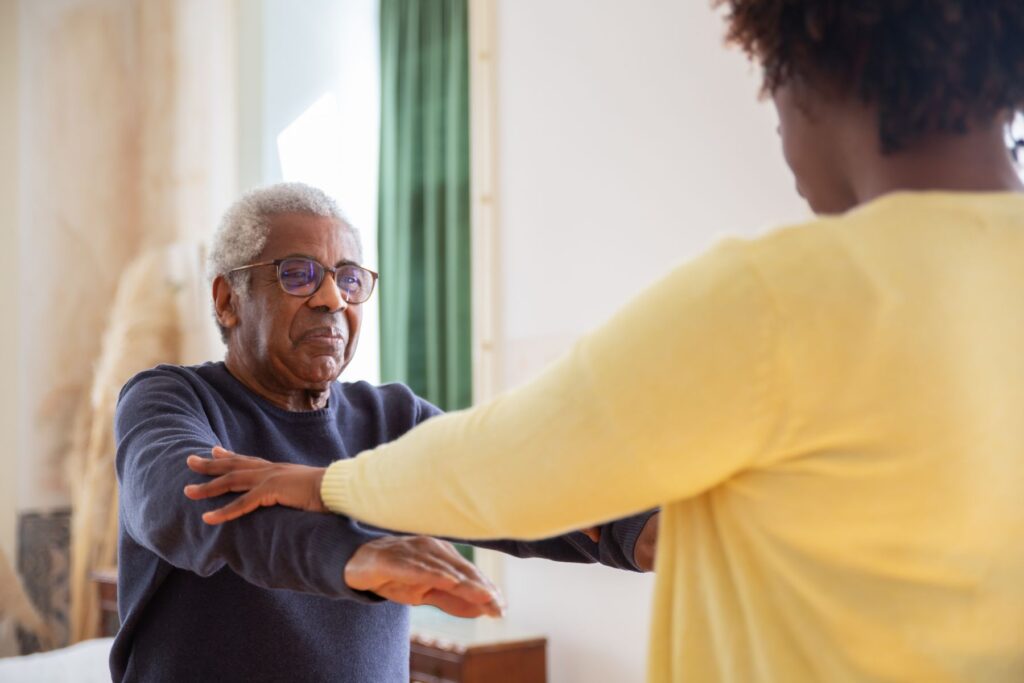
Photo: Kampus Production on Pexels. Illustrative image of assisted exercise.