Cycling can make exercise feel possible when a long walk or a busy road does not. But what does pedalling actually deliver in later life? Research supports its place as aerobic activity, whilst claims about preventing falls or protecting memory need more care. The useful question is how cycling fits alongside the other kinds of movement that ageing bodies need.
What the stationary-bike research shows
A 2026 systematic review in BMC Geriatrics, led by Taiyeba Akter, examined 47 stationary-bike intervention studies involving adults aged 60 and over. Twenty-eight were randomised trials; the remainder used other designs. Some studies reported improvements in aerobic capacity or mobility, but results varied. The researchers did not pool the findings into a meta-analysis because the participants, programmes and measurements differed substantially.
That makes this evidence encouraging without giving us a reliable promise of how much an individual will improve. A supervised rehabilitation session, an interactive cycling game and a conventional exercise bike are different interventions. A result from one cannot simply be attached to every machine in a leisure centre.
The review also searched the literature only up to June 2023. Its 2026 publication date should not be mistaken for a picture containing all research published since then. Nor do its reported improvements in cognitive tests establish that cycling prevents dementia. Those are different questions requiring different outcomes and longer observation.
Fitness is one part of everyday function
The distinction matters when a study is translated into a reason to exercise. Being better at a laboratory test, finding a session manageable and becoming more independent at home are all useful possibilities. They are not interchangeable outcomes. When reading a cycling headline, ask which one the researchers actually measured.
A 2023 scoping review in Frontiers in Sports and Active Living mapped outdoor cycling research in older adults. Traffic safety was its most common topic. It also covered health benefits, transport, environmental factors and barriers to participation. That range matters: a paper about cycling is not necessarily a test of whether it improves everyday function.
Most of the individual studies were observational. An observed difference between cyclists and other people cannot, by itself, establish that cycling caused it. When considering a headline, separate the activity being described from the outcome being measured, then ask whether the study design can support a causal explanation. The review maps the research; it does not supply a personal forecast.
It is more useful to ask whether cycling offers an acceptable way to be active than to turn an observational finding into a prediction about your future. Enjoyment and access belong in that decision, even when they do not fit neatly into a fitness score.
Indoor and outdoor cycling ask different things
A 2023 scoping review of cycling in older adults deliberately separated outdoor cycling from stationary biking because their environments, safety considerations and physical demands differ. It included 123 publications: 122 individual studies plus one review. Of the individual studies, 114 were observational, and none focused exclusively on people aged 80 and over. That is a useful warning against treating “older adults” as one well-studied group.
A stationary-bike study cannot tell us whether someone can safely negotiate a junction, turn to check behind them or manage an uneven surface. Equally, enjoying an outdoor ride does not tell us which indoor programme would suit somebody recovering from illness. Choosing the setting is part of choosing the activity.
For someone considering a return to cycling, the sensible conversation may begin with getting on and off, confidence and available support. Those are questions to take to an instructor or physiotherapist where needed, rather than hurdles to ignore because a study reported a health benefit. There is no requirement to choose the most demanding version for the activity to be worthwhile.
Pedalling does not cover every movement need
NHS guidance on osteoporosis prevention distinguishes aerobic exercise from weight-bearing and resistance exercise. Cycling is not weight-bearing activity: it does not ask the feet and legs to support body weight in the way walking does. Weight-bearing and resistance activities have an important place in bone health.
This does not make cycling a poor choice. It means its strengths should not be used to erase the rest of the picture. An exercise diary full of rides can still prompt a conversation about suitable resistance work and activity on the feet. The relevant mix depends on health, ability and previous fractures.
The same NHS guidance advises people with osteoporosis to discuss a new exercise programme with their GP or health specialist. Adding jumps or heavy lifting from a generic online routine is not the necessary next step. For a person with fragile bones, the question is which additional activities are appropriate and how to perform them safely.
Effort matters more than a display setting
NHS adult activity guidance includes riding a bike among moderate activities and fast or uphill cycling among vigorous ones. Moderate effort makes you warmer and breathe faster whilst still allowing conversation, but not singing. A bicycle’s resistance number alone cannot establish that level for everyone.
The guidance sets a population aim of 150 minutes of moderate activity or 75 minutes of vigorous activity weekly, alongside strengthening work. This is a framework for discussing overall activity, rather than an instruction to complete that amount immediately on a bicycle. The NHS advises speaking to a GP first after a long period without exercise or where medical concerns exist.
For people with heart conditions, the British Heart Foundation’s advice on safe exercise limits stresses individual pacing and slower beginnings and endings. It also cautions that wearable heart-rate readings are not always accurate. A number on a screen should not overrule symptoms or a rehabilitation team’s advice.
Stop exercising for chest pain, palpitations, dizziness or light-headedness. Symptoms that do not settle quickly with rest need urgent medical advice, as the BHF explains. A stationary setting removes traffic from the session; it does not make these symptoms safe to push through.
What this means in practice
For adults aged 65 and over, NHS guidance combines aerobic activity with strength, balance and flexibility, and encourages breaking up long periods of inactivity. These are useful prompts for a conversation about cycling this week:
- Identify the purpose of a possible ride: enjoyable activity, transport or a supervised fitness session. Let that purpose guide the questions you ask about setting and support.
- If you have been inactive or have medical concerns, discuss suitability and intensity with your GP before starting. Bring up difficulty getting on or off equipment, too.
- Look over your week for strength, balance and flexibility opportunities as well as pedalling. Ask for help choosing suitable activities if falls or unsteadiness are concerns.
- Before using unfamiliar gym equipment, request an induction. NHS bone-health guidance recommends asking an instructor when equipment or technique is unclear.
- For an existing cardiac rehabilitation plan, check how cycling fits with the team’s advice. Discuss symptoms or an uncertain effort level instead of using a machine score as clearance.
What we don’t know
The evidence does not supply one best cycling programme for every person over 60. Different populations, settings and outcomes leave substantial uncertainty about who benefits most and what carries over into everyday life. Indoor and outdoor findings should remain clearly labelled.
We also cannot infer fewer fractures, fewer falls or prevention of dementia from better fitness or test performance alone. Those outcomes need direct investigation. For now, cycling can have a useful place in an activity plan, with its role chosen around the person and the other movement they need.
A bicycle offers one way to keep moving. The strongest case for it is a suitable, manageable place in everyday life, with expectations that match the evidence.
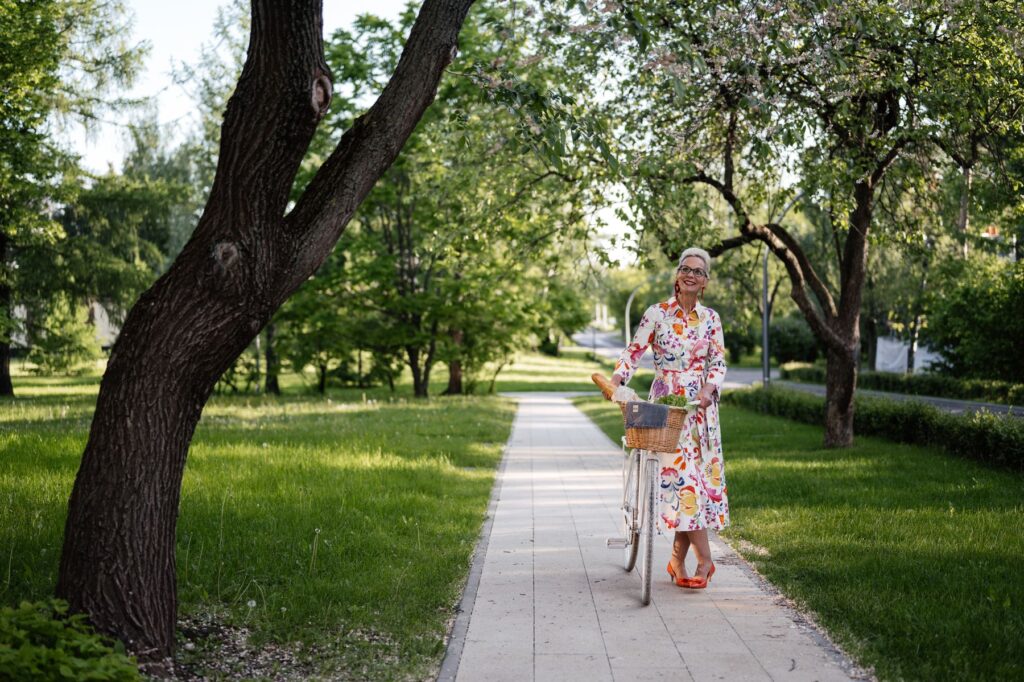
Photo: SHVETS production on Pexels. Illustrative image of a person walking a bicycle.