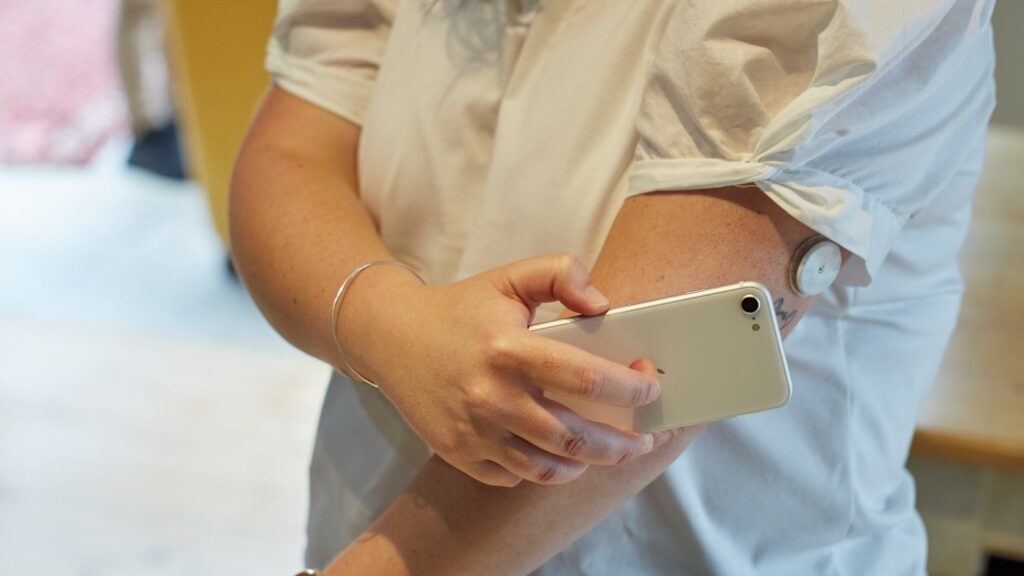
Continuous glucose monitors have moved from diabetes clinics into the wellness market. That does not make them useless for adults without diabetes, but it does change the standard of proof. A sensor can reveal glucose patterns that a fasting blood test misses. It cannot, by itself, tell someone which foods are healthy, whether a spike is dangerous, or whether they should change medication, fasting, or carbohydrate intake.
What a CGM actually measures
A continuous glucose monitor, or CGM, estimates glucose in the fluid between cells every few minutes. The reading is close to blood glucose, but it is not identical to a laboratory blood draw or a finger-stick test. The National Institute of Diabetes and Digestive and Kidney Diseases explains that CGMs use a small sensor under the skin and may still need comparison with a finger-stick reading when accuracy is uncertain, alarms sound, or treatment decisions are being made.
That matters more outside diabetes care than it first appears. In a person using insulin, the clinical question is often immediate: is glucose too low, too high, rising, or falling, and what does the treatment plan say to do next? In a person without diabetes, the question is usually vaguer: what does this curve mean for future risk, diet quality, energy, or ageing? The device can generate data either way. The interpretation is the hard part.
Why the wellness version is tempting
The appeal is obvious. HbA1c and fasting glucose are static summaries. A CGM shows the moving picture: breakfast, a late dinner, a poor night of sleep, a hard workout, alcohol, illness, stress, and a walk after lunch. It turns metabolism into a visible trace.
The CDC’s guidance on continuous glucose monitors notes that CGMs are becoming more widely available for people with diabetes and prediabetes, and even for people without either condition, sometimes for nutrition or fitness goals. That wider access is a cultural shift as much as a medical one. It gives people feedback that used to require a prescription pathway. It also invites people to treat every rise after food as a problem to solve.
What we have is a useful measurement technology entering a setting where normal ranges, treatment thresholds, and outcomes are much less settled.
The strongest evidence remains in diabetes
CGMs have their clearest clinical role in diabetes, especially when insulin, hypoglycaemia risk, or medication adjustment is part of care. A 2024 systematic review and meta-analysis in Diabetologia found that CGM use in adults with type 2 diabetes modestly improved HbA1c and several CGM-derived measures compared with self-monitoring of blood glucose. That is not a trivial finding. It is also not evidence that every healthy adult benefits from wearing a sensor.
Diabetes is a high-signal use case. The glucose range is wider, the risks are clearer, and the action pathway is more defined. For someone using insulin, a falling glucose line can prompt a safety action. For someone without diabetes, the same graph may trigger anxiety, unnecessary restriction, or a diet change based on a single meal test.
The device is the same. The clinical context is not.
What CGMs may show before diabetes
The more interesting non-diabetes question is whether CGMs can detect early metabolic dysfunction before standard tests do. A 2024 systematic review in Clinical Nutrition examined glycaemic variability in people without diabetes and found that variability was higher in prediabetes and may relate to beta-cell dysfunction. The review was cautious: many included studies were cross-sectional, and associations with obesity, blood pressure, blood lipids, fatty liver, and insulin sensitivity were less clear.
That is a useful distinction. If CGM variability is consistently linked to future type 2 diabetes or vascular outcomes, it could become a risk marker. But a risk marker is not the same thing as a consumer diet score. Most adults do not need to treat a single high post-meal peak as a diagnosis, especially after a large carbohydrate meal, poor sleep, illness, or intense exercise.
A 2026 study of more than 8,000 adults without diagnosed diabetes, published in Communications Medicine, compressed CGM data into three features: mean glucose, variability, and autocorrelation. Those features were associated with markers of vascular and liver health in a subset of participants. The result is promising for research. It does not yet give an individual wearing a two-week sensor a validated treatment algorithm.
Behaviour change is plausible, not guaranteed
CGMs can change behaviour because feedback is immediate. If a person sees a large rise after a sweet drink and a smaller rise after the same meal followed by a walk, the lesson is hard to ignore. That is the mechanism most wellness companies are selling: visibility creates better choices.
The evidence is still developing. A 2024 systematic review and meta-analysis of randomised trials looked at CGM as a behaviour-change tool in populations with and without diabetes. The broad pattern suggests CGM feedback can improve some glucose-related outcomes, but the trials vary by population, duration, counselling, baseline risk, and what participants were asked to change.
That matters because the sensor is rarely the whole intervention. Some studies combine CGM with coaching, diet advice, exercise prompts, or medication review. If the numbers improve, the credit may belong to the whole support system, not the adhesive patch on the arm.
The diet trap: lower spike does not always mean better food
A CGM sees glucose. It does not see fibre quality, protein adequacy, sodium, saturated fat, micronutrients, food enjoyment, social context, cost, or disordered-eating risk. A meal that produces a flatter glucose curve is not automatically the healthier meal.
This is where the consumer use case can go wrong. Oats may raise glucose more than cheese. A banana may raise glucose more than a processed low-carbohydrate snack. That does not make the latter the better long-term choice. Glucose is one metabolic signal among many, and it is heavily shaped by portion size, prior meals, sleep, stress, menstrual phase, gut transit, fitness, and what else is eaten at the same time.
For people with a history of eating disorders, obsessive tracking, health anxiety, or unnecessary carbohydrate restriction, CGM data may do more harm than good. For people with diabetes, pregnancy, symptoms of hypoglycaemia, unexplained weight loss, excessive thirst, frequent urination, or recurrent infections, the right next step is medical assessment, not self-experimentation with a consumer dashboard.
What this means in practice
- Use a CGM result as a conversation starter, not a diagnosis, especially if you do not have diabetes.
- Look for repeated patterns across ordinary days rather than judging a single food from one meal.
- Keep glucose in context with HbA1c, fasting glucose, blood pressure, lipids, waist, sleep, activity, medicines, and family history.
- Do not change diabetes medication, fasting duration, or carbohydrate intake to chase flatter curves without clinical advice.
- Be cautious if tracking tends to increase anxiety, restriction, or compulsive checking; more data is not always better care.
- Seek medical input for very high readings, recurrent low readings, symptoms of diabetes, pregnancy-related concerns, or any glucose result that conflicts with how you feel.
What we do not know
We do not yet know whether CGM use in adults without diabetes prevents diabetes, cardiovascular disease, dementia, cancer, or premature death. The plausible pathway runs through earlier risk detection and better behaviour, but plausible pathways are not outcomes. The field needs longer trials that compare CGM feedback with cheaper, simpler supports such as structured nutrition counselling, walking after meals, sleep improvement, weight-loss support where appropriate, and standard blood testing.
We also do not know the best thresholds for action in lower-risk adults. Diabetes care has established metrics such as time in range. Wellness use borrows the same visual language, but the risk meaning is not identical. A short-lived rise after food may be normal physiology. Persistent elevation, frequent nocturnal lows, or high variability may deserve attention, but the interpretation should be tied to symptoms, risk profile, and confirmatory tests.
CGMs are best understood as high-resolution measurement tools. For adults without diabetes, they may reveal useful patterns, but the evidence does not support treating the graph as a diet plan, a longevity score, or a substitute for clinical judgement.
Photo: Sweet Life on Unsplash.