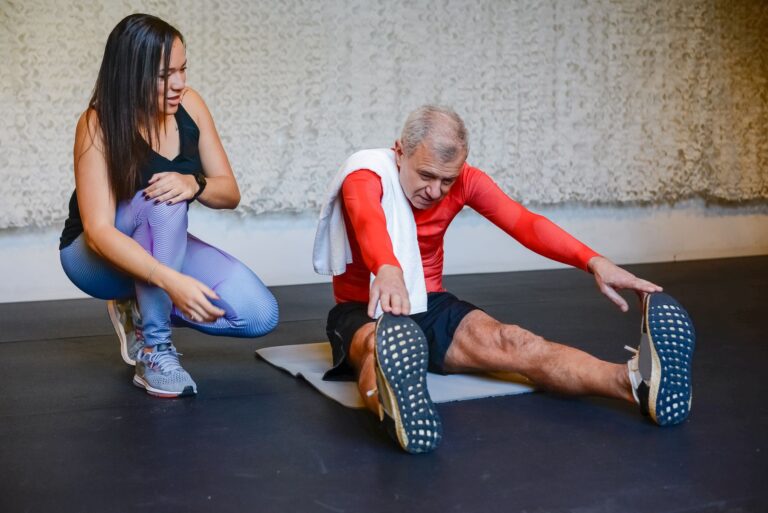
Strength training after 40 is often sold as a way to hold ageing at bay. The evidence is less cinematic and more useful: progressive resistance work can help adults maintain strength, support muscle tissue, and, in some groups, improve measures linked with bone health. The important part is the progression. The body adapts to load, but joints, tendons, blood pressure, confidence, and fracture risk all need a vote.
Why lifting matters after 40
The case for strength training in midlife begins with a simple observation: muscle is not just gym tissue. It is the tissue that helps people rise from a chair, carry shopping, climb stairs, recover from a trip, and keep enough physical reserve for illness or surgery. Adults tend to lose muscle mass and strength with age, though the speed varies widely by activity, diet, illness, medication, and starting point.
Public-health guidance has moved accordingly. The WHO physical activity guidelines recommend muscle-strengthening activities for adults alongside aerobic activity, and they frame progression cautiously: doing some activity is better than none, and inactive adults should start with small amounts before increasing frequency, intensity, and duration. That is not bodybuilding advice. It is a population-level nudge towards preserving function.
Longevity claims need more care. A 2022 systematic review and meta-analysis indexed in PubMed found that muscle-strengthening activity was associated with lower risks of all-cause mortality and several major non-communicable diseases. Associated is the key word. Cohort studies can adjust for many differences between people who lift and people who do not, but they cannot prove that dumbbells caused the lower risk.
Muscle size and strength are related, not identical
After 40, the useful target is not simply bigger muscles. Hypertrophy, maximal strength, power, balance, and confidence under load are overlapping outcomes, not the same outcome. A person can add some muscle without becoming much better at standing quickly; another can improve strength through practice and neural adaptation before visible muscle changes appear.
This distinction matters because everyday function is often about force at the right moment. Getting up from the floor, catching yourself on a step, or lifting a suitcase into an overhead rack asks for coordination as well as tissue. Exercises that train a pattern safely and repeatedly may therefore matter as much as the number on the weight.
That is why the best evidence-led programmes tend to progress gradually. They increase load, range, repetitions, or control only when the previous level is tolerable. The marker is not soreness or exhaustion. It is repeatable effort with stable technique and no worrying pain.
Bone responds to load, but slowly
Bone is living tissue, and it responds to mechanical stress. The evidence is strongest when the load is meaningful and repeated over time, but the clinical promise is narrower than many headlines suggest. Strength training should not be presented as a substitute for osteoporosis assessment or treatment when those are indicated.
The often-cited LIFTMOR randomised trial in the Journal of Bone and Mineral Research tested supervised high-intensity resistance and impact training in postmenopausal women with low bone mass. The intervention improved lumbar spine and femoral neck bone-density measures, and functional performance improved too. The safety detail matters: participants were screened, the programme was supervised, and the authors reported only one minor adverse event in the training group.
That does not mean a person with osteoporosis should copy a high-intensity protocol from the internet. Low bone density, previous fracture, spinal pain, balance problems, and medication history can change which movements are sensible. The responsible conclusion is that bone can respond to loading in selected adults, not that heavy lifting is automatically safe for every skeleton.
Fall risk is more than leg strength
Strength helps, but falls are not caused by weakness alone. Vision, footwear, medication effects, blood-pressure drops, sleep, home hazards, reaction time, and balance all play a role. Treating strength training as a complete fall-prevention plan would overstate the evidence.
A 2019 Cochrane review of exercise for preventing falls found high-certainty evidence that exercise reduced the rate of falls in community-dwelling older adults. The strongest signal was for balance and functional exercises; programmes combining several exercise types, commonly balance and functional work plus resistance training, probably reduced falls. The review was uncertain about programmes made up mainly of resistance exercise alone.
For a reader over 40, the practical lesson is not to avoid lifting. It is to avoid pretending lifting covers everything. A rounded approach includes lower-body strength, balance, stepping practice, ankle and hip control, and enough aerobic work to keep fatigue from turning ordinary tasks into risky ones.
How cautious progression changes the risk
Strength training has risks because all physical activity has risks. The common problems are musculoskeletal: irritated tendons, back pain, shoulder pain, or flare-ups of an old injury. Serious events are uncommon in well-matched programmes, but the risk rises when load, speed, breath-holding, fatigue, or impact outrun the person’s current capacity.
Progression is the dull part that makes the useful part possible. A set that feels easy today can be made harder next month by using slightly more weight, a slower lowering phase, an extra set, a deeper but comfortable range of motion, or a more demanding variation. None of those changes needs to happen at once.
Breathing deserves special mention. Heavy straining with a held breath can spike blood pressure temporarily. That does not make resistance training off-limits for everyone with hypertension, but it is a reason for people with uncontrolled blood pressure or cardiovascular disease to get individual advice before lifting heavy.
Who should get medical guidance first
Most healthy adults can begin with modest resistance work, but some readers should not treat a general article as clearance. The National Institute of Arthritis and Musculoskeletal and Skin Diseases advises people with low bone density, osteoporosis, or other physical limitations to talk to a health care provider before starting an exercise programme, and MedlinePlus gives similar advice for people with diabetes, heart disease, lung disease, or another health condition.
That makes individual guidance especially important for anyone with diagnosed osteoporosis or high fracture risk, a recent fracture, unexplained bone pain, uncontrolled hypertension, known heart disease, chest pain, fainting, a new neurological symptom, significant joint pain or injury, pregnancy, frailty, or very low recent activity.
Guidance does not always mean avoidance. It may mean supervised exercise, cardiac rehabilitation, physiotherapy, modified ranges of motion, lower starting loads, avoiding loaded spinal flexion, or monitoring blood pressure. The point is matching the stress to the person in front of it.
What this means in practice
- Think of strength training as function first: standing, carrying, climbing, pushing, pulling, and steadying yourself.
- Start below your maximum capacity if you are new or returning after a break; progress one variable at a time.
- Include balance and functional movements if fall prevention is part of the goal; resistance work alone is not the whole evidence base.
- For bone health, treat heavier loading as something to earn gradually and, with osteoporosis or fracture risk, to plan with a qualified clinician.
- Avoid breath-holding and maximal straining if blood pressure or heart disease is a concern unless your clinician has cleared that style of effort.
- Stop and seek advice for chest pain, fainting, sharp pain, neurological symptoms, or pain that worsens session to session.
What we don’t know
The evidence is strong enough to say that resistance training can improve strength and physical function, and that muscle-strengthening activity is part of credible public-health guidance. It is not strong enough to assign one universal programme after 40, or to promise that lifting will prevent fractures, falls, dementia, diabetes, or early death.
Many longevity findings are observational. People who lift may also sleep differently, eat differently, have different incomes, receive different medical care, or have fewer limitations before they start. Trials can answer narrower questions about strength, bone density, and function, but they are often shorter than the outcomes readers care about most.
The honest message is still encouraging. Strength training after 40 is not a youth-preserving trick. Done progressively, and adapted for medical risk, it is one of the clearer ways to keep the body useful for the decades ahead.
Photo: Ron Lach on Pexels.