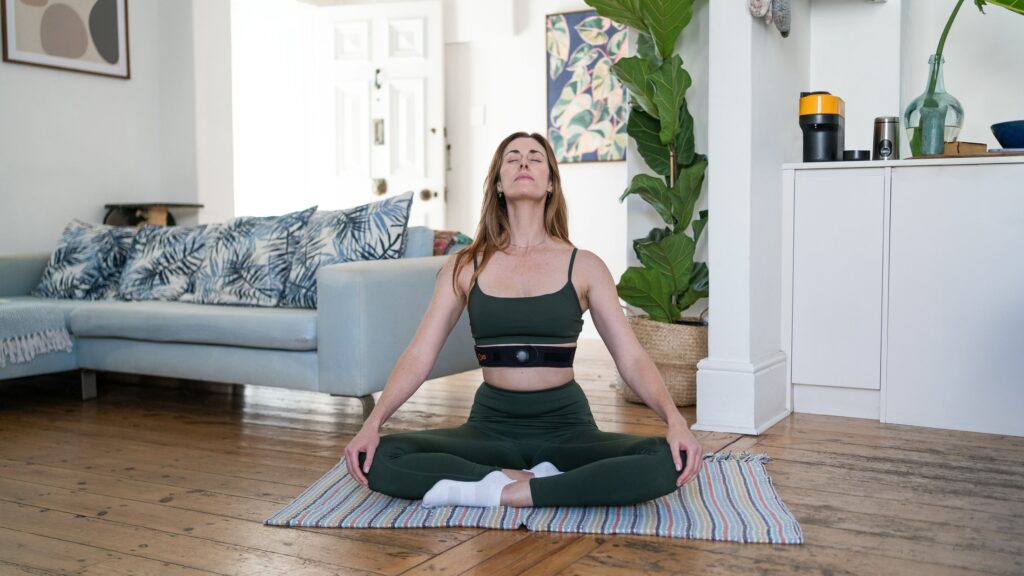
At 8.47 on a Tuesday evening, the mat can look less like a wellness object than a small negotiation with the day. The email has been sent, the kitchen has gone quiet, and the body is still behaving as if something is due. Yoga enters that moment with a reasonable promise: not cure, not transformation, but a way to give the stress response a different set of instructions.
What yoga can reasonably claim
The best case for yoga and stress is not mystical. It is behavioural and physiological. A session usually combines slow movement, attention to sensation, controlled breathing, and a predictable sequence. Each of those elements can pull attention away from rumination and towards interoception, the brain’s reading of the body’s internal state.
That does not mean yoga switches off stress. The stress response is not an error message; it is a normal adaptation to demand. The more useful question is whether yoga can lower perceived stress enough, often enough, to matter in ordinary life. On that point, the evidence is encouraging, but not clean.
A 2024 systematic review and meta-analysis in Frontiers in Psychiatry looked at randomised trials of yoga in stressed adults. It found short-term reductions in perceived stress compared with passive control groups, such as wait-list or no-treatment conditions. The authors rated the evidence as low quality, partly because the trials were small, varied, and often difficult to blind. That phrasing matters. Low quality does not mean useless. It means the effect is plausible, but the estimate is less sturdy than a headline would like.
The active ingredient is probably not one thing
Yoga is often discussed as if it were a single intervention. It is not. A gentle Hatha class, a breath-led restorative session, a vigorous vinyasa flow, and a Kundalini protocol are not interchangeable exposures. Some classes emphasise mobility and strength. Others are closer to relaxation training. Many contain breathing practices that overlap with stress-management techniques already studied outside yoga.
This is why the mechanism is difficult to pin down. Was the benefit from breath pacing, from muscular release, from quiet social contact, from expectancy, or from simply having protected time away from demands? The answer may be yes, in some changing mixture. For a reader deciding what to do this week, that uncertainty is not fatal. For someone claiming yoga is a targeted treatment for the nervous system, it is.
For stress, the label on the class matters less than the dose and tone. A class that leaves someone sore, breathless, and secretly annoyed may still be good exercise, but it is a poor recovery signal. A better starting point is a predictable sequence with enough movement to occupy attention and enough stillness to let the breath lengthen. Props are not a sign of failure here. They are often what allows the body to stop guarding.
It may help anxiety, but CBT still has the stronger case
Stress and anxiety are neighbours, not synonyms. Stress usually has a recognisable pressure point. Anxiety can become more diffuse, more anticipatory, and harder to interrupt. Yoga research sometimes blurs these categories, which is one reason the claims around it can travel faster than the evidence.
The National Center for Complementary and Integrative Health summarises the anxiety evidence cautiously. Its review of mind and body approaches for stress and anxiety notes that yoga may help some anxiety symptoms, but the evidence is mixed and methodologically limited. A particularly useful example is a randomised clinical trial published in JAMA Psychiatry comparing Kundalini yoga, cognitive behavioural therapy, and stress education for generalised anxiety disorder. Yoga performed better than stress education at 12 weeks, but it was not as effective as CBT. That is a helpful boundary. Yoga can be supportive; it should not be sold as a replacement for evidence-based care when anxiety is persistent or impairing.
The body learns safety through repetition
One quiet advantage of yoga is its repeatability. A person who practises the same short sequence several evenings a week may begin to associate certain cues with downshifting: the mat, the slower exhale, the first supported forward fold, the final stillness. Psychology has a word for this kind of learning, conditioning. The body does not merely respond to the pose; it responds to the context that predicts the pose.
This is also why an overambitious class can backfire. If yoga becomes another performance task, the nervous system receives a different message. The heart rate climbs, the breath becomes forced, and the mind starts scoring the session. For stress reduction, the useful class is often the one that feels almost underwhelming. The point is not to master the posture. It is to create conditions in which attention and breathing become less defended.
Safety is mostly straightforward, with exceptions
For healthy adults, yoga is generally considered a safe form of physical activity when taught appropriately. The NCCIH guidance on stress and relaxation practices notes that injuries can occur, most often sprains and strains, and that older adults may need particular caution. It also flags a less visible issue: some relaxation practices can occasionally increase anxiety, intrusive thoughts, or a fear of losing control, especially in people with certain psychiatric conditions or histories of trauma.
That last point is often skipped in wellness writing because it complicates the mood. It should not be skipped. A practice that asks someone to close their eyes, focus inward, and notice bodily sensation is not universally calming. For some people, external orientation, eyes-open movement, or a trauma-informed teacher may be the difference between useful and unpleasant.
What this means in practice
- Start with 10 to 20 minutes, not a 90-minute class, if the goal is stress reduction rather than fitness.
- Choose gentle, breath-led formats: restorative, Hatha, beginner flow, or yoga nidra may suit stress better than intense power yoga.
- Keep the effort at a conversational level. If you are bracing, competing, or holding your breath, the session has drifted from the purpose.
- Use the same short sequence for two weeks before judging it. The cue-response pattern matters.
- If anxiety rises during stillness, keep your eyes open, orient to the room, or switch to walking. Calm is not the only valid outcome.
- Use yoga as an adjunct. Persistent anxiety, panic, trauma symptoms, or depression deserve proper clinical assessment and treatment.
What we don’t know
The evidence base still has several unresolved problems. Trials often use different yoga styles, different session lengths, and different definitions of stress. Many compare yoga with doing nothing, which makes it hard to know whether yoga itself is superior to another structured, supportive activity. Long-term follow-up is thin. Safety reporting is also inconsistent, which means absence of reported harm is not the same as proof of no harm.
There is also the placebo problem, though the word can be misleading. Expectancy, teacher warmth, group belonging, and the relief of scheduled time are not fake experiences. They are part of how human interventions work. The scientific question is whether yoga adds something specific beyond them. The honest answer is that it may, but we cannot yet separate the pieces very well.
The bottom line
Yoga is best understood as a structured way to practise downshifting. It can reduce perceived stress in the short term, especially when the alternative is no deliberate recovery practice at all. Its strongest use is modest and practical: a repeatable ritual that helps the body recognise that the day is no longer asking quite so much of it.
Photo: Angelina Sarycheva on Unsplash.