Nuts have the kind of health halo that invites overstatement. They are linked with better heart outcomes, they can improve parts of a lipid profile, and they are easier to add to a real diet than many wellness prescriptions. But the evidence is strongest when nuts replace less useful snacks, not when they are treated as a daily handful of insurance.
Why nuts keep showing up in heart-health advice
The case for nuts starts with a simple observation: they package unsaturated fats, fibre, plant protein, minerals, and polyphenols in a small, energy-dense food. That does not make them magic. It does make them a plausible replacement for biscuits, crisps, processed meats, or sweet snacks, which is where much of the practical value sits.
The British Heart Foundation frames nuts this way, noting that they are high in fat but mainly contain unsaturated fats rather than the saturated fat that tends to raise LDL cholesterol. Its practical advice is also deliberately modest: choose unsalted nuts, watch portions, and do not assume that honey-roasted or chocolate-coated versions are the same thing as plain nuts.
That may sound less exciting than the usual nutrition headline. It is also closer to the evidence. Nuts are not a treatment for high cholesterol, a substitute for statins where those are indicated, or a way to cancel out a poor overall diet. They are one food group that can make a heart-healthier eating pattern easier to live with.
The lipid evidence is useful, but not dramatic
The strongest clinical argument for nuts is their effect on blood lipids. An updated systematic review and meta-analysis of randomised trials concluded that nut intake can reduce total cholesterol, LDL cholesterol, and triglycerides, with little effect on HDL cholesterol. That is a useful signal because LDL cholesterol is one of the better-established causal risk factors for atherosclerotic cardiovascular disease.
Still, the word to notice is “can”, not “will”. Trial results depend on the dose of nuts, the comparison diet, the person’s baseline lipid profile, and whether nuts are added on top of usual eating or used to replace something else. A handful of almonds instead of a pastry is a different intervention from a handful of almonds after dinner because an app said you had not hit a fat target.
This is why “eat more nuts” is less helpful than “swap one less useful snack for a small portion of unsalted nuts”. The first advice can simply add calories. The second changes the pattern.
Observational studies support the pattern, with caveats
Population studies often find that people who eat nuts more frequently have lower rates of cardiovascular disease. A 2023 review of nuts and cardiovascular outcomes reported consistent associations between higher nut consumption and lower cardiovascular risk, especially for coronary heart disease.
That is encouraging, but observational nutrition research is never clean. People who regularly buy and eat nuts may also exercise more, smoke less, have higher incomes, cook more often, and follow other health advice. Researchers adjust for those differences, but adjustment is not erasure. The nuts are part of a pattern, not a controlled laboratory switch.
Maren Cole’s rule of thumb applies here: if a food looks good in trials and also fits a healthier dietary pattern in cohort studies, it is reasonable to use it. It is not reasonable to pretend the food has been isolated from the rest of life.
Portion size is where the argument gets practical
Nuts are nutrient dense and calorie dense. That is not a flaw; it is the reason they are satisfying. But it means the useful dose is small. NHS healthy-eating guidance says that unsalted nuts can be a good snack, while also noting that they are high in fat and should be eaten in moderation.
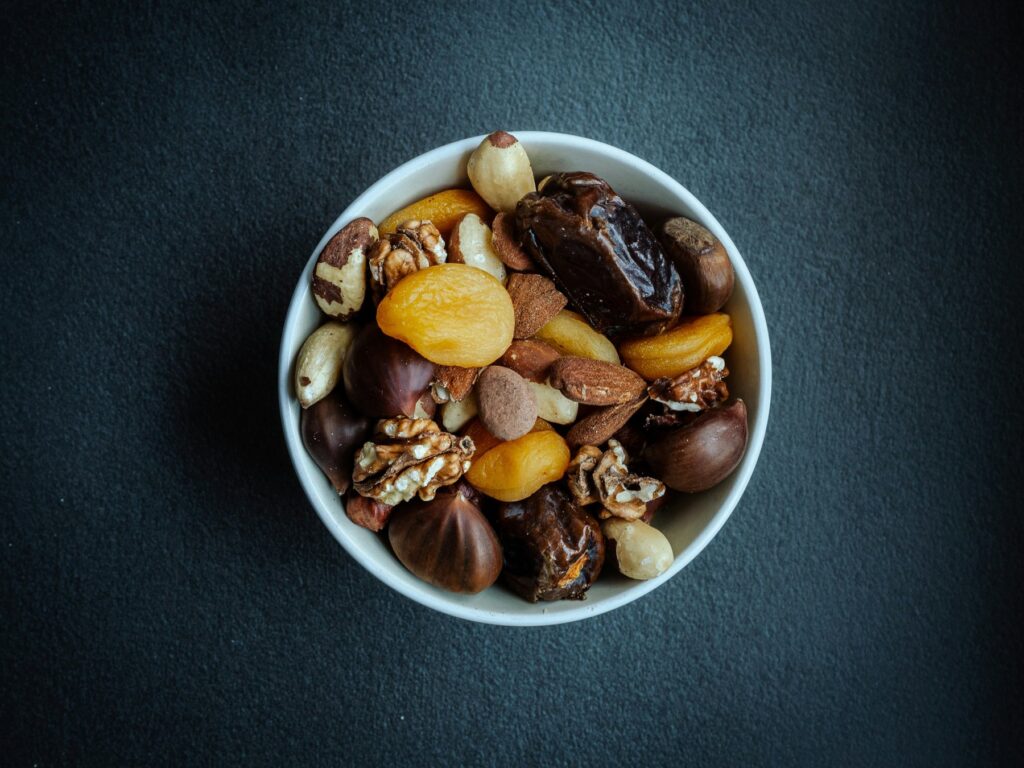
For most adults, a practical serving is roughly a small handful, about 25-30g. That might be almonds, walnuts, pistachios, hazelnuts, peanuts, or a mixed portion. There is no convincing reason to treat one nut as the heroic option for everyone. Walnuts bring more alpha-linolenic acid, almonds are familiar and easy to find, pistachios often slow people down because they come in shells, and peanuts are cheaper, even though they are technically legumes.
The form matters. Plain or dry-roasted unsalted nuts are the cleanest option. Salted nuts can be a problem for people trying to reduce sodium. Sweetened nut mixes, yoghurt-coated nuts, and snack bars with a token scattering of nuts are often confectionery with better public relations.
Food replacement matters more than food addition
The most common mistake is to ask whether nuts are “healthy” in isolation. A better question is what they replace. If they replace a packet of crisps, a chocolate bar, or a refined-carbohydrate snack, the trade is likely favourable. If they are added to an already adequate diet because a headline promised a lower heart risk, the case is weaker.
This is true of most single-food nutrition advice, but nuts make the issue obvious. They are easy to overeat because they are compact and palatable. A family-sized bag beside a laptop is not the same dietary choice as a measured handful with fruit or yoghurt.
There is also a budget point. Nutrition advice often assumes that everyone can buy small bags of walnuts and pistachios without noticing the price. They cannot. Peanuts, mixed nut pieces, and own-brand unsalted nut mixes may deliver most of the practical benefit at lower cost. The heart does not require luxury packaging.
Who needs to be more cautious
Nut allergy is the obvious exception, and it is not a small one. Anyone with a known nut or peanut allergy should follow medical advice rather than general nutrition guidance. Whole nuts are also a choking risk for young children, though that is less relevant to LiveWellBell’s usual readership.
People with chronic kidney disease, complex cardiovascular medication plans, or specific dietary restrictions should be more careful with broad advice about nuts, especially high-potassium choices or heavily salted products. For most people, the issue is simpler: choose unsalted, keep the portion modest, and make the swap intentional.
It is also worth saying that nut butters are not automatically equivalent. A peanut butter made only from peanuts and perhaps a little salt is close enough for many purposes. A chocolate-hazelnut spread is not a nut-health intervention. The front label rarely tells the whole story.
What this means in practice
- Use nuts as a replacement snack, not an extra daily obligation.
- Keep the serving to a small handful, roughly 25-30g, most days you choose to eat them.
- Pick unsalted nuts where possible, especially if blood pressure is a concern.
- Buy the affordable version you will actually use: peanuts, mixed nuts, or nut pieces are fine.
- Pair nuts with fruit, yoghurt, oats, or salads rather than eating from a large open bag.
- Treat sweetened, chocolate-coated, or highly salted products as sweets or snacks, not heart-health foods.
What we don’t know
We do not know the perfect nut, dose, or timing for longevity because that is not how the evidence has been built. Trials can measure changes in cholesterol or triglycerides over weeks or months. Cohort studies can track disease outcomes over years. Neither can fully answer whether a specific person should eat almonds rather than peanuts, or whether breakfast is better than afternoon.
We also do not have proof that adding nuts to an already heart-healthy diet meaningfully reduces events for everyone. The benefit is likely largest when nuts displace foods higher in saturated fat, refined starch, added sugar, or salt. That is less glamorous than “eat this daily for longevity”, but it is more useful.
The fair conclusion is that nuts earn a place in the diet. They do not earn a shrine. Use them as a practical swap, keep the portion honest, and let the rest of the plate do the harder work.
Photo: Metin Ozer on Unsplash.