Most strength advice tells older adults to lift carefully, which is sensible, but incomplete. Daily life rarely asks for strength slowly. Catching a stumble, rising from a low chair, and climbing stairs all depend on producing force quickly. Power training tries to practise that missing piece: lift with intent, lower with control, and leave the circus tricks out.
Why speed matters after midlife
Strength is the maximum force a muscle can produce. Power is force produced quickly. The distinction sounds technical until you watch someone try to stand up from a chair without using their hands. The legs do not merely need to be strong enough; they need to create force before balance, confidence, or the moment has passed.
That is why muscle power has become a useful idea in ageing research. A 2022 systematic review and meta-analysis in JAMA Network Open described power training as moving the weight fast during the lifting phase, then lowering under control. Across 20 randomised trials in community-living adults aged 60 and older, the authors found a modest improvement in physical function compared with traditional, slower strength training, while also stressing that the evidence was low certainty.
The key word is modest. Power training is not a replacement for ordinary resistance training, and it is not a promise of youth. It is a small adjustment to how some exercises are performed. For many adults over 50, that adjustment may be more relevant to the body’s daily demands than another set of very slow repetitions.
Power training is not jumping training
The phrase can sound more dramatic than the work itself. In most research settings, power training does not mean depth jumps, sprint drills, or complicated athletic moves. It often means a familiar exercise performed with a faster lifting phase: stand up briskly from a chair, press a weight up with intent, or pull a cable quickly enough that the movement is crisp rather than grinding.
A 2022 systematic review in the European Review of Aging and Physical Activity made that point by separating muscle power, activity-based tests, and daily physical activity outcomes. The authors found that power training tended to outperform conventional strength training on muscle power and some activity tests, but the translation into everyday activity was less clear.
That is a useful boundary. Training can make a person quicker in a controlled test without proving that they walk more, fall less, or live independently for longer. Good exercise advice should keep both facts in view: the signal is promising, but the outcomes that matter most are harder to measure.
What the studies suggest so far
The strongest case for power work is not that it builds bigger muscles. It is that it may improve the kinds of tasks older adults recognise immediately: getting up, walking, turning, stepping, and recovering from awkward positions.
In a 2023 systematic review and meta-analysis in Archives of Physical Medicine and Rehabilitation, power training improved performance on timed up-and-go and 30-second sit-to-stand tests more than other exercise approaches in older adults who could exercise independently. Those tests are not perfect replicas of real life, but they are not abstract laboratory measures either. They ask whether the body can move quickly enough to do practical work.
The broader resistance-training message has also become less fussy. The American College of Sports Medicine’s 2026 update emphasised that the biggest gain comes from moving from no resistance training to some regular resistance training, rather than fine-tuning every variable. An ACSM summary of the updated resistance-training guidelines put the practical point plainly: consistency matters more than programme complexity.
Power training fits inside that frame. It is not the first priority for someone who is not lifting at all. The first priority is to begin resistance training in a form that can be repeated. Once that base exists, a little speed may make the work more useful.
What a sensible session looks like
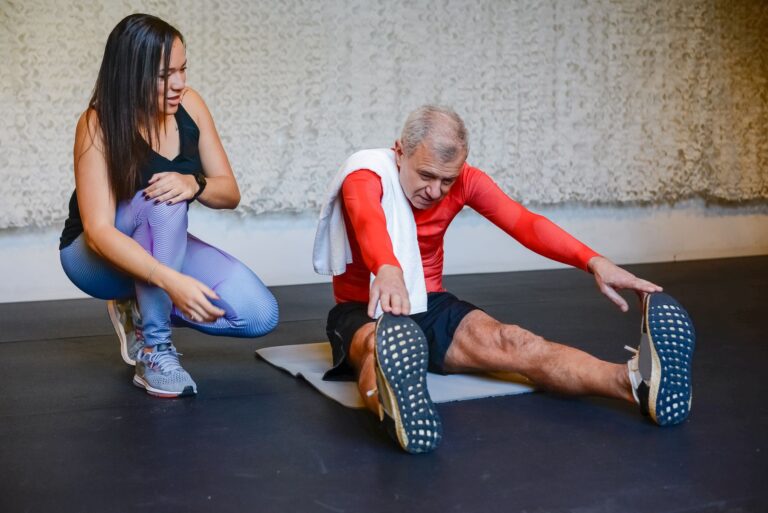
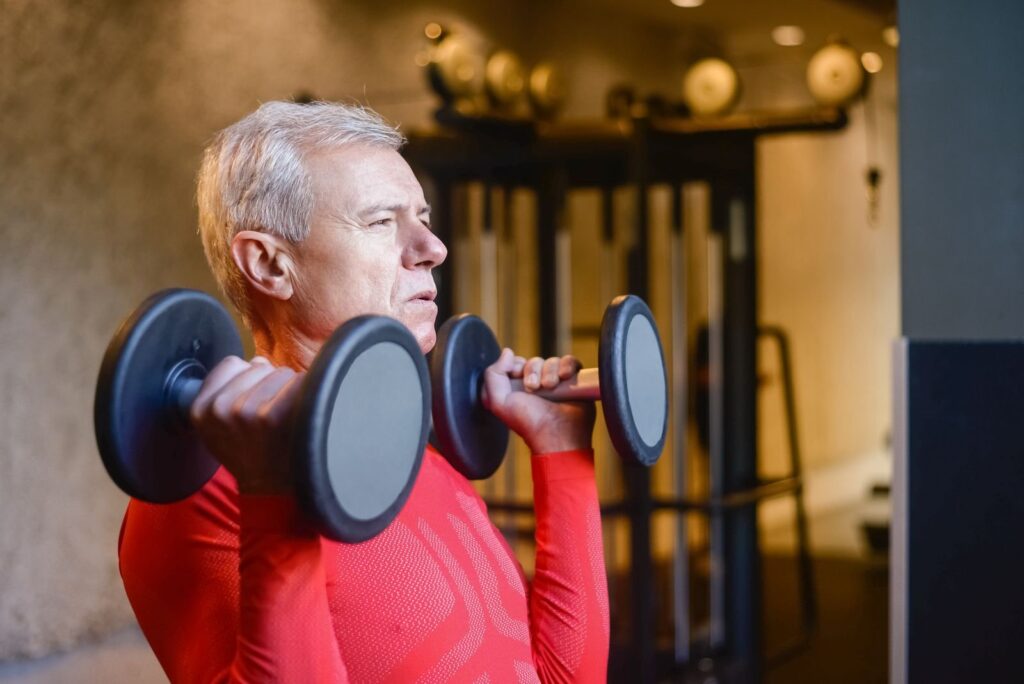
A power-focused set should look controlled from the outside. The lifting phase is quick, but not desperate. The lowering phase is slower, deliberate, and quiet. If the movement turns into swinging, shrugging, twisting, or holding the breath, the load is too heavy or the exercise is the wrong one.
For many people, the simplest starting point is a sit-to-stand. Use a firm chair. Stand up quickly enough that the movement has purpose, then sit down under control. If that is too easy, hold a light dumbbell close to the chest. If it is too hard, use a higher chair or keep the hands lightly available for balance.
Upper-body options can be just as plain: a chest press with a light dumbbell, a seated row with a band, or a standing cable press in a gym. The same rule applies. Move the weight up or towards you with intent, then return it slowly. The exercise should finish with a little effort left, not with a last repetition that turns ugly.
How heavy is heavy enough?
Power training usually uses lighter loads than maximal strength training because speed is the point. If the weight moves slowly from the first repetition, it is no longer power work. A practical range is a load that feels moderate, allows tidy technique, and can be moved quickly for about six to ten repetitions.
This is where older adults are often given worse advice than younger adults. They are told to be cautious, and caution becomes trivial. A weight so light that it floats up without effort may be safe, but it may not train much. The better target is a load that asks for attention without forcing strain.
One useful test is repetition quality. The first repetition should be quick. The last should still be recognisably quick. When the speed clearly falls away, the set has done its job. There is no extra virtue in grinding through slow repetitions under the banner of power.
Who should be more careful
Power training is still resistance training, and resistance training is not equally simple for everyone. People with unstable angina, uncontrolled blood pressure, recent surgery, unexplained dizziness, severe joint pain, or a history of falls should get individual clinical guidance before adding faster lifting. The same applies after a fracture or during rehabilitation from a neurological condition.
That does not mean speed is only for the already fit. It means the entry point matters. A physiotherapist may start with supported sit-to-stands, step-ups, or very light band work. A gym coach may choose machines because they reduce the balance demand. The principle can be scaled down without abandoning it.
Pain is also information. Muscle effort is expected. Sharp joint pain, breathlessness out of proportion to the task, chest symptoms, or dizziness are not signals to push harder. They are reasons to stop and reassess.
What this means in practice
- Keep ordinary resistance training as the base: two or three weekly sessions is enough for most recreational lifters.
- Add one or two power-style exercises after warming up, using light-to-moderate loads and clean technique.
- Think “quick up, slow down” on moves such as sit-to-stands, presses, rows, step-ups, or leg presses.
- Stop each set when the movement slows noticeably or form begins to change.
- Choose supported exercises first if balance is uncertain; the point is speed of force, not a balance test.
- Ask for professional guidance if you have recent falls, cardiovascular symptoms, uncontrolled blood pressure, or complex joint pain.
What we don’t know
The evidence is encouraging, but it is not complete. Many trials are small, short, and conducted with older adults who are healthy enough to exercise independently. That leaves open the question of how well the findings apply to frailer people, people with multiple long-term conditions, and those who have never done resistance training.
We also do not yet know the ideal dose. Researchers can compare programmes, but real lives are not research protocols. A person may walk, garden, care for grandchildren, carry shopping, and lift once or twice a week. The best power-training dose inside that mixture is likely to vary by baseline strength, confidence, pain, and supervision.
The most honest answer is also the most useful one. Power training is not a stunt, and it is not essential for everyone this month. It is a practical addition for people who already lift, or are ready to start, and want their training to look a little more like the movements they hope to keep.
Speed, used carefully, belongs in later-life training. Not because older adults need athletic tricks, but because life keeps asking the body to move before it has time to negotiate.
Photo: Kampus Production on Pexels.