Stretching has a modest but useful claim on our time: it can increase how far a joint moves. A 2023 research review supports that benefit, but does not establish that becoming more flexible prevents falls or extends life. For someone over 60 deciding where stretching belongs, the useful question is what movement they want to make easier, rather than how far they can reach.
What the stretching studies actually measured
In a 2023 systematic review and meta-analysis of 77 studies, researchers found that repeated stretching improved joint range of motion in healthy participants compared with control conditions. Static stretching, which involves holding a position, was among the approaches that improved this outcome. The finding supports flexibility training for flexibility; it does not settle every claim made for a stretching routine.
Range of motion is a measurement of movement at a joint. It is different from a person’s report of feeling less stiff, and different again from managing a difficult everyday task. These outcomes may all matter to a reader, but an article should name which one the researchers measured before discussing what the results might mean outside the laboratory.
The review also found substantial variation between studies. That matters when someone turns a pooled result into a promise about their own shoulders or hips. It describes an average response across research settings, rather than a guaranteed improvement for each person or each movement. Its participants were healthy, so applying the findings to painful or restricted joints requires additional care.
Strength training can improve flexibility too
A separate 2023 review in Sports Medicine, covering 55 studies, found that resistance training could also improve range of motion. In the comparisons available, the researchers detected no significant difference between resistance training and stretching for that outcome. This challenges the idea that lifting weights inevitably makes a person less flexible.
The result does not mean the two activities are interchangeable in every respect. A comparison of flexibility outcomes cannot establish that stretching supplies the strength benefits of resistance exercise. Nor does an average finding tell someone which exercise is suitable for an injured shoulder. The review assessed healthy participants and included different exercises, joints and training approaches.
For a reader with limited time, the useful implication is that exercise categories can overlap. A strength session need not sit on one side of an imaginary divide and flexibility work on the other. Equally, someone who enjoys stretching does not need to abandon it because another activity can improve the same measurement. The choice should follow the person’s goals and circumstances.
More reach is only one part of moving well
A more direct comparison comes from a 2021 review of 11 trials involving 452 participants. It also found no significant difference between strength training and stretching for improving range of motion, whilst emphasising that the studies differed considerably in their participants and methods. That is useful corroboration, with an equally useful warning against treating the result as universal.
Consider the difference between an exercise goal and a life goal. “Increase my shoulder range” describes a physical measurement. “Reach a cupboard more comfortably” describes a task. A person might care about both, but a study reporting the first has not automatically demonstrated the second. Asking about the task keeps the discussion relevant without pretending a laboratory measurement is meaningless.
The NHS explanation of strength and flexibility treats flexibility as one component of physical activity. It describes flexibility exercise as improving movement around joints and helping with everyday activities. That is a useful reason to consider flexibility work, without treating a general guidance page as proof that a particular stretching routine prevents injury or protects against all the difficulties of ageing.
Where stretching fits in a wider week
The NHS activity guidance for adults aged 65 and over includes aerobic activity, strength, balance and flexibility. It recommends activities that improve strength, balance and flexibility on at least two days a week, alongside at least 150 minutes of moderate-intensity activity, or an appropriate vigorous equivalent. These are population guidelines, rather than an individual rehabilitation prescription.
That wider picture is a useful answer to the question of whether stretching is “enough”. Enough for what? If the goal is greater range of motion, stretching has supporting evidence. If the goal is a rounded activity week, flexibility is one element in the NHS framework. A short stretching routine should not be presented as having demonstrated every benefit associated with being physically active.
For someone who has been inactive, the NHS advises building up gradually. Its guidance also advises speaking to a GP before starting if a person has not exercised for some time, or has medical conditions or concerns. There is no need to treat a weekly activity target as a test to pass immediately. The starting point and the suitability of the activity matter.
Discomfort is a reason to reconsider the movement
Mayo Clinic’s guidance on stretching safely distinguishes gentle tension from pain. It advises warming up first, moving smoothly without bouncing and avoiding painful stretches. Stretching is therefore a poor setting for the idea that greater discomfort necessarily means greater progress. A photograph of an impressive position is not an instruction to reproduce it.
The same guidance cautions that an existing injury or chronic condition may require changes to technique; stretching a strained muscle can cause further harm. Someone with these concerns can discuss suitable movements with a clinician or physiotherapist. A general article cannot establish whether a particular stretch is appropriate for a particular painful joint.
Persistent tightness also deserves a better question than “how much harder should I pull?” In Mayo Clinic’s 2021 discussion of hamstring tightness, physiotherapist Lauren Hubbard explains that the sensation can persist despite flexibility. Continuing tension or pain that stretching does not relieve warrants assessment to identify its cause. That is a reason to seek an explanation, rather than to escalate the force or duration of a home routine.
What this means in practice
- Write down one movement you would like to make easier this week. Use it as a question for an instructor or physiotherapist, rather than choosing an extreme flexibility target from a photograph.
- Review the balance of your activity week against the NHS framework. Notice whether flexibility work has crowded out opportunities for aerobic activity, strength or balance.
- If you choose to stretch, use a reputable demonstration and keep the movement gentle, following Mayo Clinic’s advice to warm up and avoid pain or bouncing.
- If you already do resistance exercise, ask whether your current movements address the flexibility goal you have identified. The research does not imply that everyone needs a separate, elaborate routine.
- If an injury, medical condition or persistent pain affects the movement, discuss an appropriate approach with a clinician or physiotherapist before trying to push further.
What we don’t know
The reviews discussed here cannot tell us that a stretching routine extends life, prevents fractures or preserves independence. Their central outcome was joint range of motion. Establishing those broader benefits would require studies that measured them directly. This is a boundary around the evidence, rather than proof that stretching has no other value.
We also cannot extract one ideal routine for every adult over 60 from studies of varied healthy populations. Averages leave questions about individual joints, existing conditions, long-term adherence and the amount of change that makes everyday life easier. The honest promise is narrower than the advertising: flexibility can improve, but the value of that improvement depends on the person and the task.
Stretching earns its place when its purpose is clear. A comfortable movement that serves an everyday goal is a more useful ambition than winning a contest of reach.
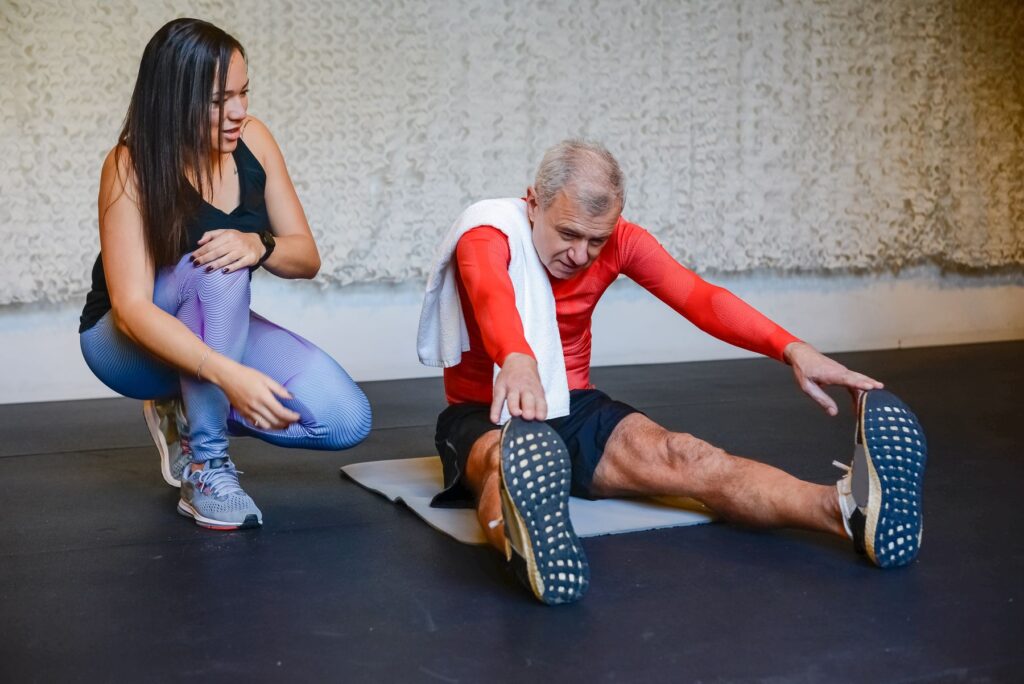
Photo: Kampus Production on Pexels. Illustrative photograph; the position shown is not an exercise prescription.