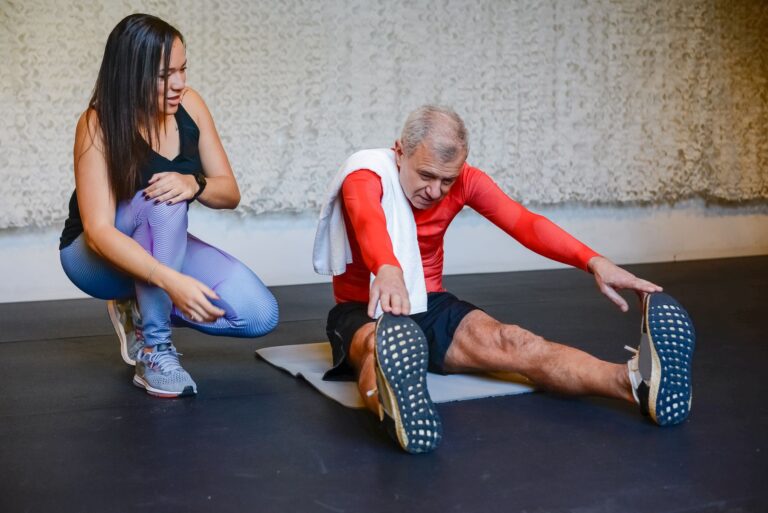
There is a useful detail hidden inside almost every strength exercise: the lowering phase. When you lower into a chair, bring a shopping bag to the floor, or return a dumbbell to your side, the working muscle is lengthening whilst producing force. That is eccentric work. It may offer a small extra strength benefit for healthy older adults, but it is not a shortcut and it needs a gentler introduction than social media usually suggests.
The part of the repetition most people overlook
A squat has two halves. Standing up asks the thighs and hips to shorten under load; lowering asks them to control the same load as they lengthen. A biceps curl works similarly: lifting the weight is the concentric phase, lowering it is the eccentric phase.
This is not a specialised trick. Eccentric contractions are part of ordinary movement, especially whenever we descend stairs, sit down, or put an object down carefully. The ability to control that part of a movement is one reason researchers are interested in eccentric exercise for older adults, for whom strength and fatigue can both shape whether a programme is sustainable.
It is also the reason to be careful with the word more. A muscle can handle more force while lengthening, but unfamiliar eccentric loading can leave it sore. The useful question is not whether lowering a weight is better than lifting it. It is whether a modest, controlled emphasis on lowering helps someone train consistently and function better.
What the recent evidence found
A systematic review published online in 2025 and assigned to a 2026 issue compared eccentric resistance training with conventional resistance training in healthy older adults. The review found a small advantage for eccentric training in measured strength, but not clear superiority for functional capacity, muscle power, or muscle size.
That distinction matters. A small difference on a strength test is not the same thing as proof that eccentric training will make a person less likely to fall, climb every staircase more easily, or live longer. Both forms of training improved function and strength within their own programmes. The evidence supports eccentric work as one reasonable ingredient, not as a replacement for standard resistance training.
The size and design of the studies also set the boundary. Participants were generally healthy older adults, interventions differed, and some programmes used machines or supervised settings that cannot be copied exactly at home. The science is clearer for the ability to build strength than for a unique real-world advantage from the lowering phase alone.
Why slower lowering can feel different
Deliberately lowering for two or three seconds changes the task. It makes a light dumbbell, resistance band, or body-weight movement feel more demanding without adding much external load. For a person returning after a break, that can be useful: the exercise is challenging enough to require attention, yet the equipment need not be intimidating.
But slower is not automatically safer. A new eccentric emphasis can produce delayed muscle soreness; a review of eccentric exercise in older adults discusses both this side effect and the need to progress the work sensibly. If exercise causes new sudden pain, unusual swelling, redness, or dizziness, stop and monitor the symptoms. Seek medical advice if they persist or worsen, and seek urgent help for severe chest pain or pressure, severe unexplained breathlessness, or faintness; NHS physiotherapy guidance sets out those cautions.
The practical translation is pleasantly unglamorous. Choose familiar movements, use support where balance is uncertain, and lower under control. A sit-to-stand from a firm chair, a supported step-down from a low step, or a band row with a measured return all have an eccentric component already.
Start with the exercise you can repeat
The wider resistance-training evidence points in the same direction: consistency matters more than a complicated dose. A 2025 network meta-analysis of 151 randomised trials reported that low training volume can substantially improve physical function in healthy older adults, while greater volume appeared more important for maximising strength. That is good news for beginners. A small programme that happens every week is a credible starting point.
For the first few weeks, consider one or two sets of a handful of movements on two non-consecutive days. During the lowering phase, count a calm “one, two” rather than chasing an exact tempo. The load should be light enough that the final repetitions remain controlled, but hard enough that a brief rest is welcome before the next set.
The NHS advises adults aged 65 and over to include activities that build strength, balance, and flexibility on at least two days each week. Its physical-activity guidance for older adults also recommends speaking to a GP first after a long break from exercise or when medical conditions make the right intensity uncertain. That is sensible framing for eccentric work too.
Machines, bands, and body weight all count
Eccentric training is sometimes presented as a machine-based method, because machines can make the return path predictable. They are useful, especially when a trainer or physiotherapist can set up the load. They are not essential.
Resistance bands allow a slow return, though their tension changes through the movement. Body-weight exercises are often the simplest place to learn control. For example, hold a kitchen counter lightly, rise from a chair as usual, then take two or three seconds to sit back down. The aim is not to collapse into the seat, but neither is it to hover until your knees complain.
A 2024 systematic review of elastic-band programmes found that the evidence across 28 studies supported improvements in several physical measures, whilst also noting substantial variation between studies. Its findings are a useful reminder that modest equipment can be enough to train. The band itself is not the active ingredient; progressive, tolerable effort is.
Where supervision earns its keep
There are situations where an individual prescription matters more than a general article. If you have been inactive for some time, have a health condition, have recently fallen, or are unsure what is safe, speak to a GP, physiotherapist, or qualified exercise professional before changing your programme. The NHS makes the same recommendation for older adults starting or returning to activity.
For everyone else, a simple rule helps: keep the lowering phase controlled, not heroic. Do not use a load you cannot return safely. Do not turn a handrail or a chair into a test of willpower. And leave at least a day between new strength sessions while you learn how your body responds.
What this means in practice
- Pick two familiar lower-body movements, such as a sit-to-stand and supported calf raise, plus one upper-body pull or push that feels stable.
- On two non-consecutive days this week, complete one or two controlled sets; take roughly two seconds to lower on each repetition.
- Use a chair, counter, or rail for balance when needed. Stability is part of good technique, not a concession.
- Begin with a load that leaves the last repetitions effortful but tidy. Add repetitions or a little resistance only after the same session feels manageable for more than one week.
- Expect mild, general muscle soreness when the lowering phase is new; reduce the dose next time if it interferes with normal walking, sleep, or daily tasks.
- If you have not exercised for some time, have a health condition, or have fallen recently, ask a GP or physiotherapist for an appropriate starting point.
What we don’t know
The evidence does not identify one ideal eccentric tempo, load, or programme for every adult over 60. The recent comparison studies mostly involve healthy volunteers and do not establish that eccentric training prevents falls or outperforms conventional training in everyday independence. It is also hard to separate the effect of the lowering phase from supervision, programme length, and the total amount of work people completed.
There is a further practical uncertainty: soreness can discourage the very consistency that produces benefit. More eccentric work is not necessarily better, particularly at the beginning. A programme that leaves you able to return next week is usually more valuable than a memorable first session.
Eccentric training earns its place because controlled lowering is a useful skill, not because it changes the rules of ageing. For most people, the best version is simply a familiar strength exercise performed with enough patience on the way down to make the way up count.
Photo: Kampus Production on Pexels