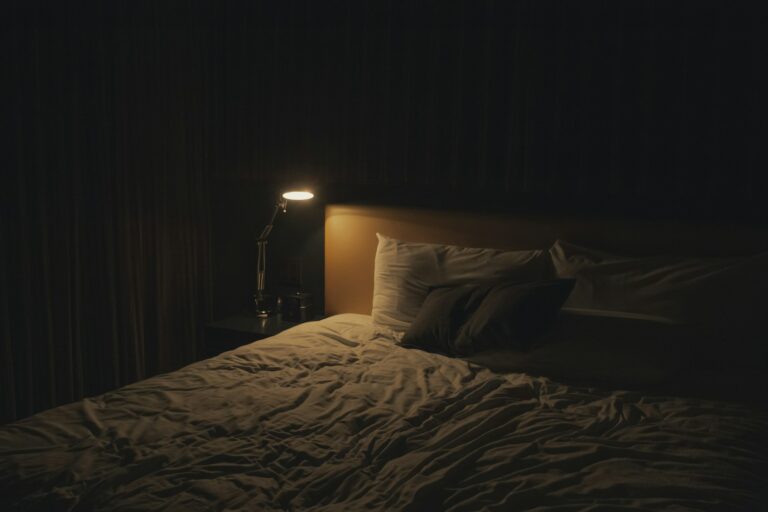
People ask the same question every week: “Will I still sleep badly if I move my coffee earlier?” The honest answer is that late caffeine can still hurt sleep, even when you are trying to be careful, because sleep is less a clock rule than a biological system. The science is clearer on what caffeine does to sleep architecture than on the exact minute the body “stops listening.” For most adults, the safer practical question is not when is a perfect cutoff, but where each person’s margin of resilience really sits.
How caffeine keeps your body in a wake-like mode
At the bedside, caffeine works like a brake release for sleep pressure. It blocks adenosine receptors, so the chemical signal that builds across the day can feel muted longer than expected. That is a robust mechanism, and in practical terms it often shows up as later sleep onset, lighter early night sleep, and more wakefulness after sleep starts. Mechanistic clarity matters because it lets us separate myth from pattern.
In short, there is no one-line “this is harmless for everyone” rule. The evidence that caffeine affects sleep is not controversial; what varies is how much it affects each person in each context. That context includes dose, time since last intake, habitual intake, sleep schedule, and basic physiology.
What stronger evidence actually says
A 2023 Sleep Medicine Reviews meta-analysis found that post-caffeine sleep changes are directionally consistent: total sleep time and sleep efficiency drop, while sleep onset delays. It also reported dose and timing as meaningful modifiers rather than optional details. In other words, caffeine timing is not just social convenience language; it is an intervention parameter with measurable effect size.
More fine-grained data from a randomised crossover trial context shows that even substantial delays can persist at lower-intensity doses when consumed within a few hours of bedtime. The pattern is similar across studies: the closer to sleep, the larger the disruption in deep sleep stability. That does not mean a single universal “no caffeine after X pm.” It means the relationship is graded, and the grading changes by person.
Official guidance still tracks this, with one important nuance: public-health pages often advise avoiding caffeine in the evening because it improves population-level sleep quality and is easy to operationalise. That is a useful default, not a universal truth with mathematical certainty for all individuals.
Why one cutoff is not a universal truth
NHS self-help guidance and AHA sleep-related summaries both sit in the same place: caffeine and sleep hygiene are linked, but real people live in varied routines. Some people get away with late tea, while others wake repeatedly after a single small cup. If we ignore this variability, the advice becomes theatrical instead of useful.
Biology explains part of it. A recent meta-analysis of controlled crossover trials described reductions in total sleep time and sleep efficiency after caffeine exposure, with age and dose as moderators. That sits alongside pharmacokinetic variability, which includes metabolism differences and interactions with medicines. Another useful anchor is pregnancy physiology: NIH Office of Dietary Supplements notes caffeine metabolism can be prolonged in later pregnancy, meaning the same routine can shift from tolerable to disruptive at life-stage changes.
The editorial implication is simple: a fixed social cutoff is a starter, not a finish. If you rely only on a calendar rule, you will misclassify many people, which is why practical protocols often work better than moral rules.
The biggest clinical pitfall is asking the wrong question
Most advice fails because people track only one event: “What time was the last cup?” That omits the sleep baseline. If your sleep is already fragmented from stress, poor light exposure, irregular shifts, nicotine, medication, or untreated breathing issues, caffeine becomes one piece of a larger pattern. For this reason, many people experience no change from a pure timing cutover, then repeat the same routine because they assume caffeine was never the cause.
The fix is not to discard caffeine’s role; it is to stop treating it like an isolated villain. A practical diagnostic sequence is usually better: (1) keep a short baseline log for one week, (2) set a temporary evening caffeine boundary, (3) review sleep onset latency, wake count, and morning sleep quality together. Only then should you judge the intervention. That is more labour, but far less guesswork.
A further pitfall is “all-or-nothing” habits. Some people abruptly remove all evening caffeine and interpret the day-after headache as proof they were never the problem. Withdrawal can mimic poor sleep recovery and confuse interpretation. That is avoidable if you test changes in staged steps, especially if you are already sleep-deprived.
What to test if late caffeine feels like your current bottleneck
This is where this article should leave you with something concrete. A staged protocol has better signal than panic:
- For 10 nights, record each caffeinated item with amount and clock time. Record one key sleep variable: sleep onset latency, one mid-point wake time, and one rating for morning energy.
- For the next 10 nights, move your final caffeinated intake window to at least 6 hours before your intended sleep time. Keep other habits unchanged.
- If you still wake badly, try a stricter 4-hour boundary for another 5–7 nights and add one compensatory step (for example: no evening nicotine/alcohol mix).
- If improvement is modest but not absent, keep the earlier boundary and compare with a one-week return-to-baseline phase.
That gives you a person-specific boundary you can trust, instead of a guess pulled from generic advice. If timing helps but sleep is still broken, the remaining bottleneck is likely outside caffeine, and your next move should be a deeper sleep assessment rather than a stricter cutoff.
Special cases you should treat differently
Some groups need stricter caution than “most adults.” In pregnancy, NHS-linked lactation guidance references on caffeine transfer and sensitivity patterns mean that both mother and infant outcomes are part of the same equation. For shift workers, circadian alignment can be already unstable; a simple “6-hour rule” can over-restrict and create unnecessary sleep debt. The better metric is sleep consistency plus late-day caffeine placement relative to your true sleep block, not the wall clock.
For people already on medicines, caffeine can amplify side effects; for people with anxiety symptoms, it can compound wakefulness signals. Mayo Clinic’s overview of safe limits is useful here because it frames tolerance and side effects together, rather than treating caffeine as either safe or dangerous in binary terms.
In these contexts, publication-worthy practical writing must avoid absolutism. The responsible posture is: yes, timing matters; no, one-size-fits-all timelines are not medicine.
What this means in practice
- Start with one week of baseline tracking before you cut anything.
- Keep a strict temporary evening caffeine boundary for 10–14 nights, then compare outcomes, not vibes.
- Use a staged plan to avoid rebound effects, especially if you are a heavy late consumer.
- Move the variable set only one at a time (timing first, then environment, then workload timing).
- Flag pregnancy, lactation, arrhythmia history, severe anxiety, or suspected sleep-disordered breathing for clinician review.
- If the pattern persists despite timing control, seek diagnostic assessment rather than escalating self-experiments.
What we don0027t know
We still do not have exact individual-dose calculators for home use that can predict your perfect cut-off with high confidence. We also still lack good real-world data for chronic, high-demand schedules under long-term caffeine adaptation. Many studies include short follow-up windows, and few map genetic factors in routine use outside specialist contexts.
So the safest conclusion is practical rather than perfect: late caffeine can undermine sleep quality for many people, the disruption is mechanistically plausible, and timing is the lever with the best day-to-day evidence-to-action ratio. The right answer is usually not elimination. The right answer is measured, person-specific timing control with parallel checks for broader sleep drivers.
Closing: Coffee is not a villain by default, and sleep is not equally fragile at the same time for everyone. The most useful move is evidence-first patterning: measure, tighten timing, and escalate only when the data says timing is not the whole story.