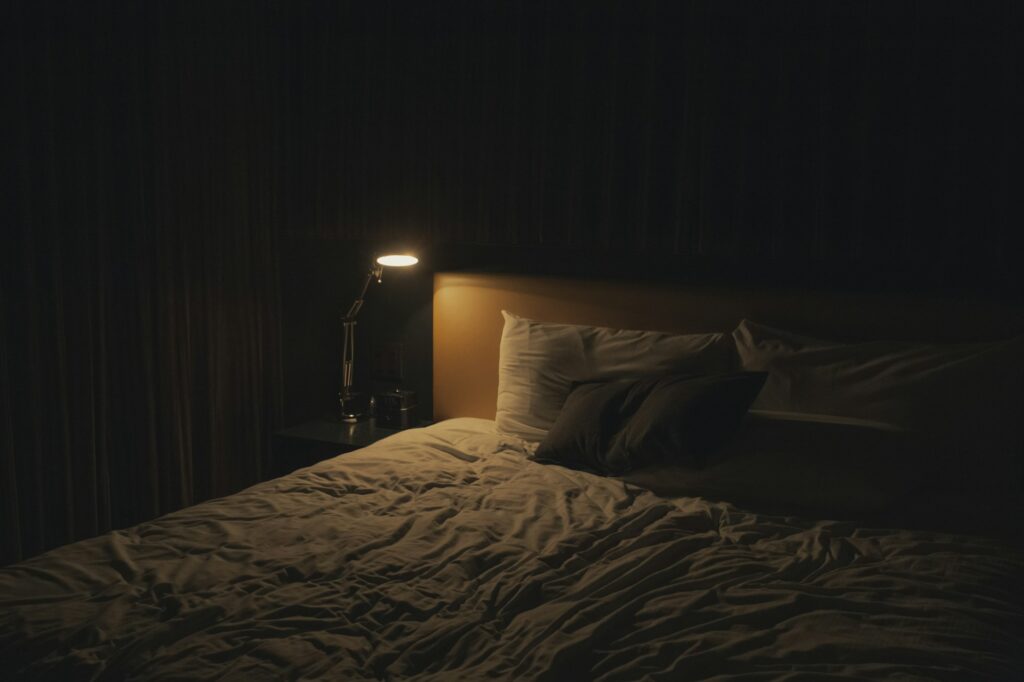
Waking at 3am feels like a private failure because the clock is so specific. It is usually nothing of the kind. For many adults, especially after midlife, the second half of the night is simply easier to disturb: lighter sleep, more REM sleep, a shifting body clock, and a brain that has had enough pressure to fall asleep but not always enough rhythm to stay there.
A 3am waking is usually a maintenance problem
Sleep medicine separates insomnia into several patterns. Some people struggle to fall asleep. Others fall asleep quickly, then wake for long stretches. The second pattern is sleep-maintenance insomnia, and it is the one that most often produces the 2am, 3am, or 4am clock-check.
The timing matters less than the pattern. One brief awakening is normal; most people wake several times and forget it by morning. The problem begins when the awakening becomes long, frequent, distressing, or paired with impaired days. A 2025 NCBI Bookshelf review on chronic insomnia describes the disorder as difficulty initiating sleep, maintaining sleep continuity, or poor sleep quality that persists despite adequate opportunity for sleep and results in daytime dysfunction.
That distinction is useful because it lowers the emotional temperature. A person who wakes at 3am is not necessarily broken, anxious, deficient in magnesium, or ageing badly. The question is narrower: what is making this part of the night unstable?
The second half of sleep is easier to disturb
Sleep is not one uniform block. Early in the night, deep non-REM sleep tends to dominate. Later, REM sleep becomes more common, body temperature begins its slow rise, and the circadian system starts preparing for morning. This is why the same sound, thought, or bladder signal that would not have woken you at 11.30pm can become enough at 3.30am.
The science is clearer for architecture than for any single remedy. A review on sleep in normal ageing notes that older adults tend to have less ability to maintain sleep, with more awakenings and longer periods awake during the night. That does not mean good sleep is over after 50. It does mean the margin for error narrows.
This is also why the usual advice to “just relax” is inadequate. Relaxation may help, but the problem is often structural: pressure to sleep has partly discharged, the body clock is moving towards morning, and the brain is nearer the surface.
Age changes the rhythm, not just the duration
People often measure sleep by hours. Duration matters, but timing and continuity matter too. With age, many adults become sleepier earlier in the evening and wake earlier in the morning. Deep sleep also tends to decline, making awakenings more memorable.
An older adult who wakes at 3am after going to bed at 9.30pm may not have a mysterious nocturnal problem. They may have shifted their sleep window too early. By 3am they have already spent five and a half hours in bed, the strongest sleep pressure has passed, and the body clock may be nudging towards wakefulness.
This is why moving bedtime earlier often backfires. It creates more opportunity to be awake in bed. The more time the brain spends awake under the duvet, the more it learns that bed is a place for vigilance rather than sleep.
Alcohol, light, temperature, and stress all show up late
Several common triggers are delayed. Alcohol is the classic example. It can make falling asleep easier at higher doses, which is why it feels helpful at first. But sedation is not the same as stable sleep. A 2025 systematic review and meta-analysis in Sleep Medicine Reviews found that alcohol changes sleep architecture, reducing and delaying REM sleep, with REM disruption worsening as dose rises.
Light can work in the other direction. Bright light late at night delays the body clock for some people, whilst very early morning light can pull wake time earlier. Temperature matters too: a warm bedroom, heavy bedding, or night sweats can turn a normal brief arousal into full wakefulness.
Stress is less tidy. Cortisol is often blamed for every early waking, but the stronger claim is behavioural: a stressed brain is quicker to attach meaning to wakefulness. The first thought is not “I am briefly awake” but “tomorrow is ruined”. That interpretation raises arousal, and arousal keeps the person awake.
When middle-of-night waking becomes insomnia
The threshold is not one bad night. Travel, illness, alcohol, family stress, a hot room, or a late meal can all disrupt sleep without creating a disorder. The concern rises when awakenings happen at least several nights a week, last long enough to cause distress, and produce daytime impairment.
There are also medical reasons not to over-normalise it. Loud snoring, witnessed pauses in breathing, morning headaches, restless legs, reflux, pain, frequent urination, medication changes, depression, and menopausal vasomotor symptoms can all fragment sleep. If these are present, treating the clock-watching alone is too narrow.
For persistent insomnia, cognitive behavioural therapy for insomnia is the best-supported non-drug approach. A CBT-I primer in the medical literature describes it as a structured treatment aimed at the thoughts and behaviours that maintain insomnia, including stimulus control, sleep restriction, cognitive work, and relaxation. Its point is not better sleep hygiene. It is retraining the relationship between bed, wakefulness, and pressure to sleep.
Clock-watching is part of the mechanism
The clock looks harmless. At 3am, it is rarely neutral. Checking the time gives the waking a story: how much sleep is left, how hard tomorrow will be, whether this is happening again. The calculation is arousing even when the answer is reassuring.
Many sleep clinicians therefore start with stimulus control. If you are awake for long enough to become frustrated, get out of bed briefly, keep the light low, do something dull, and return when sleepy. The exact minute count is less important than the principle: bed should not become a training ground for wakeful problem-solving.
This is also where sleep trackers can mislead. They can identify patterns, but they can also turn a normal arousal into a performance review. If the first act of the morning is to inspect a score, the night becomes something to pass or fail.
What this means in practice
- Anchor wake time first. Keep a steady wake time for two weeks before judging bedtime. The morning anchor is usually more powerful than an earlier night.
- Do not expand time in bed after a bad night. Going to bed much earlier often increases wakeful time in bed and weakens the bed-sleep link.
- Move alcohol earlier or skip it. If 3am waking is common, treat evening alcohol as a serious suspect, even when it helps you fall asleep.
- Hide the clock. Set the alarm, turn the display away, and remove the arithmetic from the awakening.
- Use low-light stimulus control. If wakefulness becomes frustrating, leave the bed briefly and return when sleepy rather than trying harder under the duvet.
- Screen for medical clues. Snoring, breath pauses, pain, reflux, hot flushes, restless legs, and frequent urination deserve clinical attention.
What we don’t know
We do not know why one person wakes calmly at 3am and another enters a two-hour loop of alertness. Genetics, stress sensitivity, prior insomnia, hormones, medication, light exposure, and conditioning probably all matter, and their balance differs by person.
We also do not have strong evidence that a single supplement reliably fixes sleep-maintenance insomnia. Magnesium, glycine, melatonin, and various herbal products may help selected people, but they do not replace diagnosis, circadian regularity, or CBT-I when the pattern is chronic. Melatonin, in particular, is a timing signal more than a sedative for most adults.
The cleaner claim is this: middle-of-night waking is common, patterned, and often modifiable. Treat it as a signal about sleep timing, arousal, substances, environment, or health, not as proof that your sleep system has failed.
A 3am waking is unpleasant because it feels final. Often it is just the lightest part of the night asking for steadier conditions.