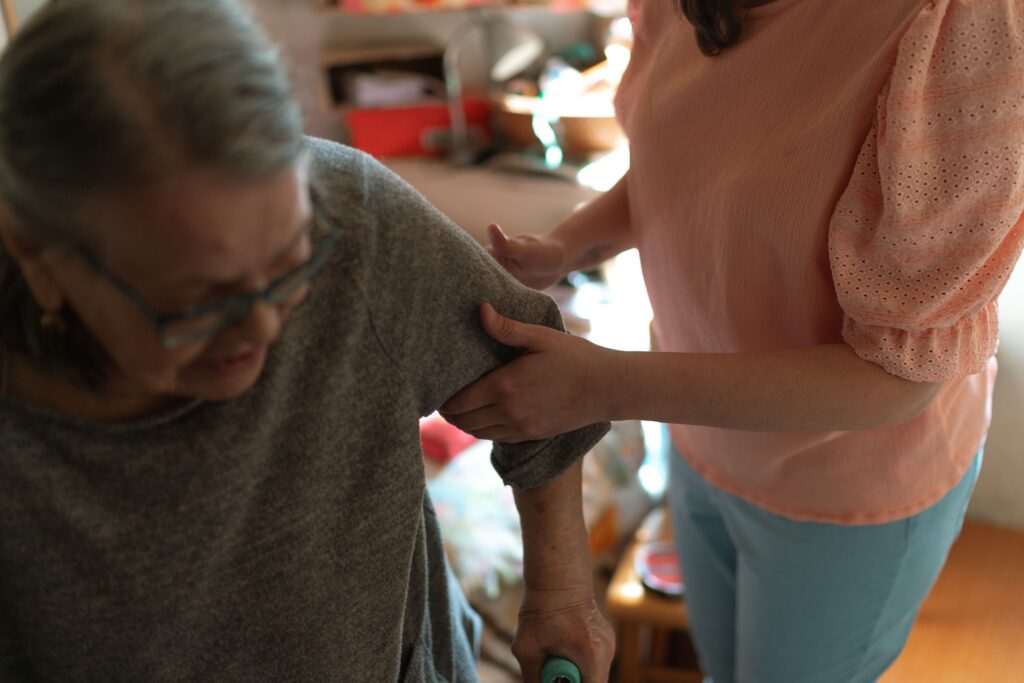
The appointment is over, but the work continues: arranging the next visit, checking who can stay, keeping track of another change. For someone caring for a relative with dementia, stress support has to fit around that work. Research suggests some programmes can help, usually modestly. The useful question is what kind of help they provide, and whether a carer can actually access it.
Start with the situation, not a resilience score
Caring can hold affection, satisfaction, worry, and exhaustion in the same day. The NHS guide to looking after someone with dementia acknowledges that the role can be rewarding as well as stressful, and describes support for carers alongside care for the person with dementia. Those two needs belong in the same conversation.
In research, “caregiver burden” is a term for the impact of caring, rather than a judgement about the person receiving care. A 2021 Cochrane review of remote carer support describes emotional, physical, social, and financial consequences. That breadth matters: an intervention may address one part of the experience without changing the others.
A more helpful opening question than “How resilient are you?” might be “Which part of the week has become hardest?” This is a way of organising a conversation, not a validated test. The answer could be uncertainty about behaviour, finding cover for an appointment, or having nobody with whom to discuss a difficult decision. Each points towards a different request. Calling all three “stress” can obscure what help is missing.
Training can give support a practical purpose
“Psychoeducation” sounds abstract. Here it means learning about the condition and ways of responding to the challenges around it. NICE’s dementia guidance recommends offering carers education and skills training, including personalised strategies, communication skills, information about services, and planning for the future. It also includes the carer’s own health and wellbeing.
This is a broader proposition than being handed a leaflet. A useful question for a service is whether there will be an opportunity to discuss the particular situations at home. Does the programme explain its content? Can it accommodate the carer’s language and preferred format? Is there a way to ask questions after a session? NICE says support should be tailored and available from diagnosis and as needed afterwards.
The distinction is not that information has no value. It is that information and supported learning are different offers. A description of dementia cannot, by itself, tell a family how their individual arrangements should work. Nor should a general article attempt that. Clinical questions about changes in symptoms, medicines, or safe care still belong with the relevant health or social care professionals.
Remote support helps some outcomes, with limits
Telephone and online support can look attractive when leaving home requires organising replacement care. But convenience and effectiveness need separate examination. In the Cochrane review, remote interventions containing training or support might slightly improve burden and depressive symptoms compared with information alone. They did not show the same advantage over usual care, waiting lists, or attention controls, and appeared to make little or no difference to health-related quality of life.
The comparison group therefore changes the interpretation. “Better than information alone” does not establish that a programme adds a meaningful benefit to an already supportive service. The review also found more dropouts from training or support programmes than from information-only interventions. Its authors noted that the availability of usual services could influence the results.
A 2024 systematic review of technology-delivered psychosocial interventions likewise reported small improvements in several carer outcomes, including depression, while warning that high risk of bias in the included trials reduced certainty. These are findings about structured interventions studied in trials. They do not validate every online group or commercial application that uses the language of carer wellbeing.
Before committing, a carer could ask who provides the support, what participation involves, and how concerns are escalated. A programme that requires an unrealistic amount of time is a poor practical fit, however encouraging its description. Difficulty attending is something a service should discuss, rather than something a family has to conceal.
A calming practice and a reduction in workload differ
Mindfulness is sometimes offered as if a calmer response will solve the whole problem. The evidence is more selective, but includes encouraging findings. A meta-analysis published online in 2023 of mindfulness interventions for dementia carers included 13 randomised trials and reported statistically significant reductions in stress and anxiety. Across the trials, it did not find significant overall immediate benefits for depression or caregiver burden. A subgroup of interventions lasting at least eight weeks did show a benefit for depression.
Those findings need to be read together. The subgroup result does not establish an eight-week treatment threshold or show that a longer programme will help every carer. The authors called for larger randomised trials with more rigorous methods to strengthen the conclusions. The evidence suggests potential symptom benefits, with uncertainty; it is not a promise of treatment success or proof that mindfulness reduces the practical demands of caring.
It helps to separate three questions: does a practice offer a welcome pause; does it improve a measured symptom; and does it change the demands of caring? They are not interchangeable. A reader need not turn a pleasant moment into a claim about treatment, cortisol, or ageing for that moment to matter.
The 2020 NICE guideline on supporting adult carers places emotional support alongside training and practical considerations. It asks services to take account of timing, accessibility, preferred format, and whether replacement care is needed to attend. This gives a useful standard against which to assess an offer: can the person use it in the circumstances they actually have?
A break needs a safe, workable arrangement
Respite care means another person looks after the person receiving care while the carer takes a break. The NHS explanation of carers’ breaks describes options ranging from help for a few hours to short stays in a care home. It also explains that council-funded support depends on assessment and that costs and arrangements vary.
The phrase “take a break” can sound simple while leaving every logistical question unanswered. Who is available? What care can they safely provide? What information do they need? A break is a plan involving another person’s needs and preferences as well as the carer’s time. There is no single arrangement this article can responsibly recommend for every family.
In England, the NHS guide to carer’s assessments explains how adults can request a free assessment through their local council. It considers the effect of caring on health, work, relationships, and free time, separately from the cared-for person’s needs assessment. An assessment does not guarantee free replacement care; help with costs may involve a financial assessment. Readers elsewhere should check their local system.
When stress needs clinical attention
Not every difficult day is a mental health disorder. Equally, the caring role should not become a reason to dismiss distress that needs assessment. The NHS stress guidance advises seeing a GP when coping is difficult or self-help is not working. It describes changes in sleep, concentration, and behaviour among possible symptoms, without making those symptoms a diagnosis.
A conversation can cover how the carer is managing and what happens if they become unable to continue safely. This is an invitation to seek individual assessment, not a suggestion to diagnose anxiety or depression from an online checklist. Carer support programmes and treatment for a mental health condition may serve different needs.
For urgent mental health help in England, call NHS 111 and select the mental health option, or request an urgent GP appointment. If someone’s life is at risk, or you cannot keep yourself or someone else safe, call 999 or go to A&E. These routes follow the NHS urgent-help guidance. Outside England, use the equivalent local urgent or emergency service.
What this means in practice
- Consider noting one difficult part of the week before a support appointment, so the conversation has a concrete starting point.
- Ask a dementia service what carer education or skills training is available, including who delivers it and how questions are handled.
- If considering remote support, check the time commitment and escalation arrangements before deciding whether it fits.
- Explore a carer’s assessment through the appropriate local service; ask separately about eligibility, replacement care, and costs.
- If coping is becoming difficult, discuss your own health with a GP rather than waiting for a carer programme to solve it.
What we don’t know
The reviews discussed here concern carers of people with dementia. They cannot establish the same effects for every other caring situation. Small average improvements also leave uncertainty about who benefits most, how long benefits last, and which elements of a combined programme matter. The technology review’s bias concerns and Cochrane’s differing comparison groups are reasons to keep claims modest.
These sources do not establish that a support programme extends a carer’s life or slows biological ageing. Nor do they identify one best programme for every family. The defensible aim is more immediate: finding support that responds to the circumstances, while recognising when clinical help is needed.
The next useful step may be a conversation about the work of caring itself. A carer’s wellbeing deserves space in that conversation, with an offer of help specific enough to assess.
Photo: Jsme MILA on Pexels. Illustrative stock photograph; the people pictured are not identified as having dementia.