Exercise snacks sound like a wellness slogan, but the term has a specific meaning in sports science: short, structured bouts of movement spread through the day rather than packed into one gym session. For people who struggle to find a 45-minute block, the question is whether these mini-sessions can meaningfully improve fitness — or whether they are simply a polite way of saying “move more often”.
What counts as an exercise snack?
Researchers do not all use the term in exactly the same way, which matters when reading headlines. In a widely cited 2022 review in Exercise and Sport Sciences Reviews, Islam, Gibala, and Little defined exercise snacks as isolated bouts of vigorous exercise lasting about one minute or less, performed periodically through the day. The aim was to interrupt long sitting and raise heart rate briefly, without requiring a full workout wardrobe or a cleared calendar.
Other trials have stretched the definition to include slightly longer bouts — stair climbs, bodyweight circuits, balance drills — provided each session stays short and repeats at least twice daily. The common thread is not intensity branding or influencer choreography. It is feasibility: movement that fits into an ordinary day.
That distinction separates exercise snacks from general advice to “take the stairs” or stand during phone calls. Snacks are deliberate, repeated, and usually vigorous enough to feel like work. They are also not a rebranded excuse to skip longer sessions if those are already realistic for you.
Why the idea gained traction
Lack of time is among the barriers adults with obesity most often report. A 2021 systematic review in PLoS ONE pooling 27 studies found lack of time was one of the three most frequently cited barriers to physical activity in adults with obesity, alongside motivation and physical discomfort. The appeal of exercise snacks is structural: if health benefits can accumulate in two-minute windows, the entry cost drops.
Sedentary time adds a second reason. The NHS advises adults to break up long periods of sitting and to aim for at least 150 minutes of moderate activity across the week. Prolonged sitting is linked, in observational research, with slower metabolism and higher risk of type 2 diabetes and some cancers — though most of that evidence shows association rather than proving that sitting alone causes disease.
The UK Chief Medical Officers’ physical activity guidelines similarly recommend reducing sedentary behaviour and building activity into daily life. Exercise snacks sit in that policy space: small doses that interrupt stillness, rather than a separate fitness subculture.
What a 2026 meta-analysis found
Until recently, the evidence was scattered across small trials with different protocols. A 2026 systematic review and meta-analysis in the British Journal of Sports Medicine pooled 11 randomised controlled trials involving 414 sedentary or physically inactive adults and older adults. Interventions lasted four to twelve weeks. Most used bouts of five minutes or less, performed at least twice daily, with activities such as stair climbing, strength exercises, or tai chi.
The clearest finding was an improvement in cardiorespiratory fitness among adults. Older adults showed gains in muscular endurance. Those outcomes are not cosmetic. Cardiorespiratory fitness is strongly associated with lower mortality risk in large cohort studies, and endurance matters for everyday tasks such as climbing stairs, carrying shopping, or recovering balance after a stumble.
The same analysis did not find consistent improvements in muscular strength, body fat, blood pressure, or blood lipid profiles. That may reflect relatively healthy baselines, short trial lengths, or simply the limits of very small total exercise volume. Exercise snacks appear useful for raising fitness in inactive people. They are not a proven shortcut to full cardiometabolic remodelling.
Adherence may be the real story
One striking result from the BJSM analysis was completion: more than 90% of participants finished prescribed sessions, and around 83% adhered to the planned routines. That is unusually high for unsupervised exercise programmes, and it matches what smaller trials have hinted at for years.
The 2022 Exercise and Sport Sciences Reviews paper argued that snacks could be a feasible, well-tolerated way to reduce the harms of sedentary behaviour while improving cardiorespiratory fitness. Proof-of-concept studies at that time were small, but the adherence signal was already visible. People often stick with what feels achievable.
That does not make snacks superior to longer exercise. It makes them competitive on the metric public health often loses: maintenance. A moderate programme abandoned after three weeks delivers less than a modest programme still happening in November.
What a snack might look like in practice
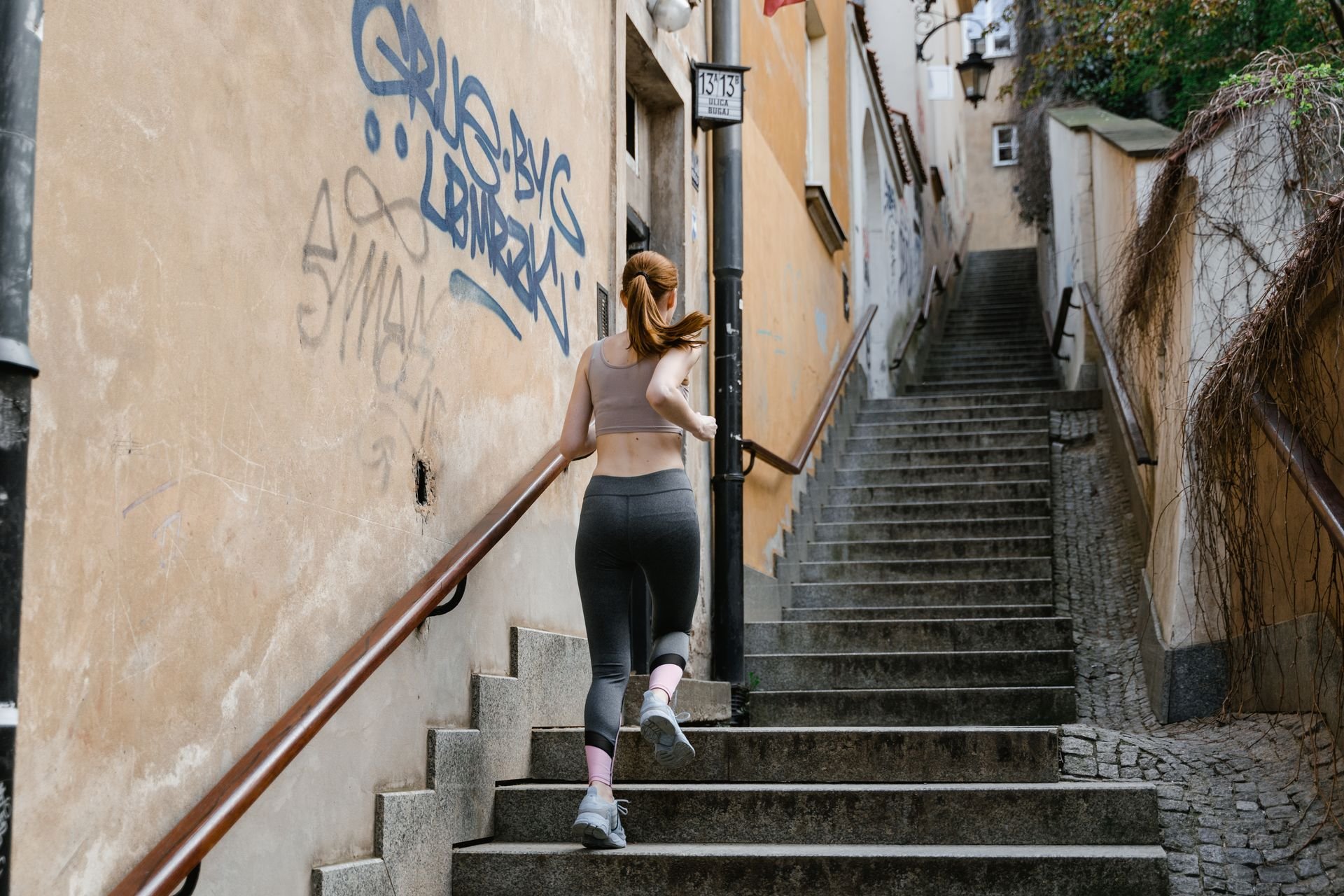
Published trials used simple, repeatable tasks rather than elaborate equipment. Stair climbing featured often — one flight walked briskly enough to raise breathing rate, repeated later in the day. Bodyweight squats, heel raises, marching on the spot, and short balance sequences appeared in older-adult protocols.
Intensity mattered. Many successful bouts were moderate to vigorous, sometimes near the top of that range. A leisurely wander to the kettle does not meet the same threshold as a brisk two-minute stair climb. The point is not exhaustion. It is a brief, honest effort that would be hard to sustain for thirty uninterrupted minutes.
Frequency mattered too. Once is a break in sitting. Twice or more daily begins to resemble a programme. The evidence base still cannot tell every reader their perfect snack, but the pattern in trials is short, hard-ish, and repeated.
Who should be cautious
Exercise snacks are not risk-free simply because they are short. Vigorous stair climbing may be inappropriate for someone with unstable angina, poorly controlled blood pressure, recent surgery, severe osteoarthritis, or a history of falls on stairs. Older adults with balance problems may need supported floor-level exercises rather than rapid stepping.
Chest pain, unusual breathlessness, dizziness, fainting, or joint pain that worsens with activity are reasons to speak with a clinician before adding vigorous bouts. Pregnancy, post-operative recovery, and some cardiac conditions may require individual guidance rather than a generic snack template.
Even for healthy adults, snacks should complement — not automatically replace — strength training, longer aerobic sessions, and mobility work when those are accessible. The BJSM meta-analysis did not show reliable strength gains. If muscle and bone health are the goal, brief bouts alone may be too narrow.
What this means in practice
- Pick one or two repeatable movements you can do safely at home or work, such as brisk stair climbs, sit-to-stand repetitions, or supported heel raises.
- Aim for brief vigorous effort, not a casual stretch — enough to raise breathing rate for one to three minutes.
- Repeat at least twice on most days; consistency across the week matters more than a single impressive bout.
- Use stable supports and sensible footwear on stairs, especially if balance or vision is a concern.
- Keep longer walks, resistance sessions, or physiotherapist-prescribed programmes in the week if you can manage them.
- Seek medical advice before starting vigorous bouts if you have heart disease, frequent falls, joint pain, or unexplained symptoms during exertion.
What we don’t know
The evidence is still young. Eleven trials and 414 participants can show direction, not final answers. Most studies ran for three months or less, in relatively inactive volunteers, with supervised or closely prompted protocols that real life may not replicate.
We do not yet know the best snack for each age group, the minimum effective dose, or how snacks compare head-to-head with traditional 30-minute workouts when total weekly time is matched. Cardiometabolic outcomes — blood pressure, lipids, insulin sensitivity — need larger and longer trials. So do diverse populations, including people with obesity, diabetes, or established heart disease.
Exercise snacks are best understood as a promising way to lower the barrier to movement, not as proof that gyms are obsolete. For inactive adults, they offer a credible path to better fitness. For everyone else, they are a reminder that small, repeated efforts can add up — provided the effort is real, the routine is safe, and the expectations stay honest.
Photo: MART PRODUCTION on Pexels.