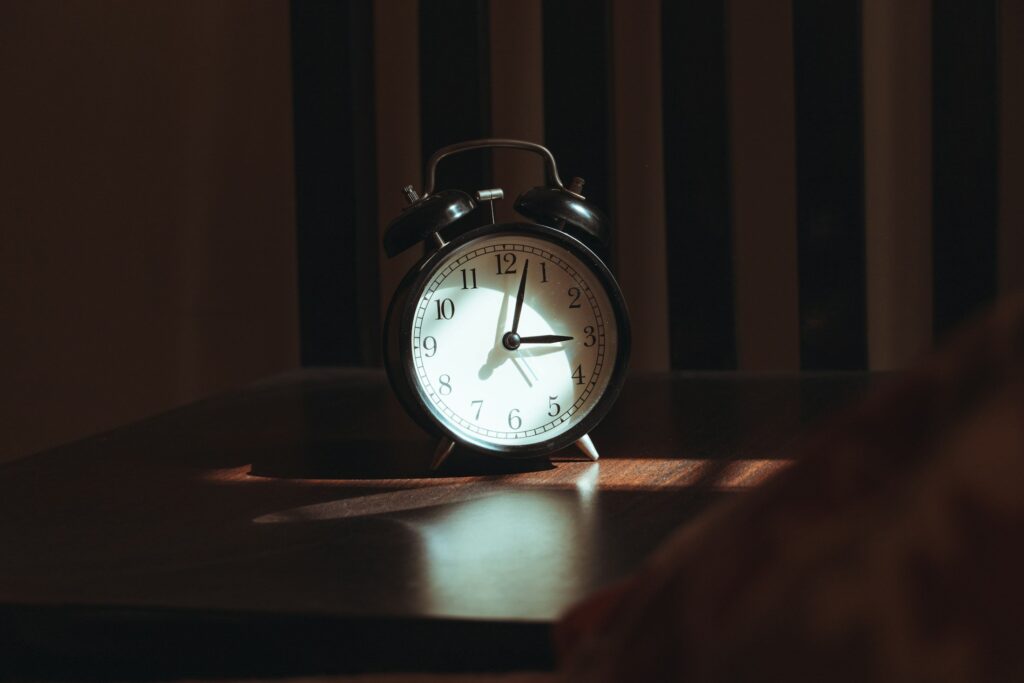
Irregular bedtimes are easy to dismiss as a modern inconvenience: a late train, a second episode, a deadline that eats the evening. The sleep science is more cautious. Regular timing is not a moral virtue, and it is not a diagnosis, but it may be one of the ways the body clock shows strain before sleep duration looks obviously wrong.
Why timing matters as much as duration
Most sleep advice begins with hours, and that is still the right starting point. Adults generally need at least seven hours of sleep, according to the American Academy of Sleep Medicine and Sleep Research Society consensus statement. But duration is only one part of sleep health. Timing tells a different story: when sleep starts, when it ends, and whether those points move around from night to night.
The body clock does not run on willpower. It is coordinated by light exposure, meals, activity, social demands, and internal rhythms in hormones and temperature. A bedtime that moves by several hours may still produce seven hours in bed, but the biological signal is less steady. That matters because sleep is not just absence of wakefulness; it is a timed physiological state.
This is where many consumer sleep scores can mislead. A tracker may congratulate a long night after a short one, whilst missing that the whole pattern has drifted. The science is clearer for regularity as a marker of circadian alignment than it is for any single bedtime being best for everyone.
What recent cohort data found
A 2026 cohort study in BMC Cardiovascular Disorders followed 3,231 people from the Northern Finland Birth Cohort 1966 for major adverse cardiac events and cardiovascular mortality. Sleep timing was measured with wearable devices at midlife, and health outcomes were tracked for roughly a decade.
The notable finding was not that everyone should be asleep by a particular hour. It was that greater irregularity in bedtime and sleep midpoint was associated with higher cardiovascular event risk, especially among people whose time in bed was shorter. Wake-time variability did not show the same clear signal in that analysis.
That distinction is useful, but it should not be overread. The study was observational, so it cannot prove that irregular bedtimes directly caused cardiac events. Irregular sleep may also reflect shift work, caregiving, stress, pain, alcohol use, illness, or economic pressure. Still, objective sleep timing over a week gave researchers a more concrete signal than the usual question, “How many hours do you sleep?”
The older evidence points the same way
The Finnish data did not appear in isolation. A prospective analysis in the journal Sleep used UK Biobank accelerometer data and reported that sleep regularity predicted mortality risk in older adults. Again, this was not proof that a tidy bedtime prevents death. It was evidence that regularity carried information beyond sleep duration.
Metabolic studies have raised similar questions. In the Multi-Ethnic Study of Atherosclerosis, a 2019 Diabetes Care analysis linked actigraphy-measured irregular sleep patterns with metabolic abnormalities, including obesity, glucose markers, and blood pressure. Some associations were cross-sectional, and some were prospective, which makes the pattern worth taking seriously whilst still leaving room for confounding.
The practical message is not that regularity outranks duration. It is that sleep health has several dimensions. A person who sleeps six hours on weekdays and nine at weekends may be solving tiredness in the short term whilst showing a rhythm problem in the longer pattern.
Why the body dislikes a moving target
Deep sleep, REM sleep, body temperature, cortisol, melatonin, hunger signals, and blood-pressure dipping all follow rhythms. These rhythms are not perfectly fragile, but they do prefer repeated cues. A regular sleep window gives the brain a more predictable chance to prepare for sleep and wakefulness.
When bedtime shifts late, several things can happen at once. Light exposure may extend into the biological night. Meals or alcohol may move closer to sleep. The next morning may still demand the same alarm, compressing sleep. Then the weekend may stretch sleep later, delaying the rhythm further. None of this is exotic biohacking language. It is basic circadian biology meeting ordinary life.
Older adults can be especially sensitive to this because sleep becomes lighter and more fragmented with age. But younger adults are not exempt. Shift workers, new parents, carers, clinicians, hospitality staff, and people with insomnia often have irregular schedules for reasons that cannot be solved by a neat bedtime reminder.
When irregular timing deserves medical attention
A variable bedtime is not, by itself, a sleep disorder. The red flags are daytime sleepiness that affects driving or work, loud snoring with pauses in breathing, morning headaches, restless legs, repeated early-morning waking with low mood, or insomnia that persists despite a stable sleep opportunity. The NHLBI guidance on healthy sleep habits explicitly frames routine as one part of sleep health, not a substitute for clinical assessment.
This distinction matters. Telling someone with untreated sleep apnoea to “keep a regular bedtime” may delay care. So might telling a night-shift nurse that consistency alone will remove circadian strain. Behavioural changes can support sleep, but they do not replace diagnosis, occupational protections, or treatment when symptoms point to something more serious.
Medication also needs caution. Sedatives, antihistamines, alcohol, cannabis products, and high-dose melatonin may appear to make timing easier, but they can create next-day impairment, interact with other medicines, or mask a treatable disorder. Anyone with bipolar disorder, epilepsy, pregnancy, complex medical conditions, or significant mental-health symptoms should be especially careful with self-directed sleep interventions.
What this means in practice
- Keep the wake-up time reasonably steady on most days, then let bedtime move earlier gradually rather than forcing sleep when you are wide awake.
- Notice the pattern over two weeks: bedtime, wake time, naps, alcohol, late caffeine, exercise, and morning light. A simple log is often more useful than a single sleep score.
- If weekends drift by several hours, narrow the gap gently. Aim first for less swing, not perfect sameness.
- Protect the hour before bed from bright light, work messages, heavy meals, and alcohol when possible; these are timing cues as much as habits.
- For shift work, caregiving, or medical causes of irregular sleep, discuss the pattern with a clinician or occupational-health service rather than treating it as a personal discipline problem.
What we don’t know
The evidence is still stronger for association than causation. People with irregular sleep often have irregular lives, and those lives may carry health risks that are hard to fully measure. Wearable data can improve timing estimates, but a week of monitoring may not capture seasonal schedules, illness, travel, or long-term stress.
We also do not know the ideal regularity target for every group. A 30-minute swing is different from a three-hour swing, and a retired person with flexible mornings is different from a junior doctor on nights. Chronotype matters too. A naturally late sleeper may do better with a stable later schedule than with an early bedtime that produces hours of wakefulness in bed.
The safest conclusion is modest: regular sleep timing is a useful signal of circadian steadiness. It belongs beside duration, sleep quality, symptoms, and medical context. It should not become another number to chase.
Bedtime regularity is not a longevity hack. It is a quiet clue. When the clock keeps moving, the useful question is not “What is wrong with me?” but “What is moving my rhythm, and is there a safer way to steady it?”
Photo: Suhas Hanjar on Unsplash.