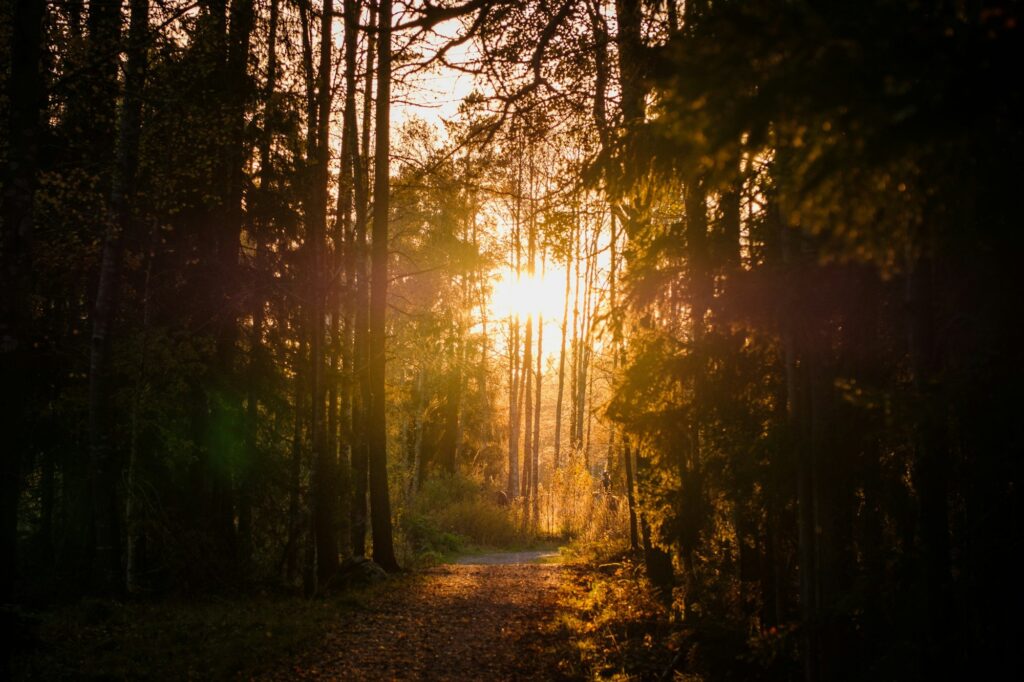
Nature is usually presented as an antidote to modern stress: a forest path, a blue horizon, ten minutes away from notifications. The evidence is more interesting than the slogan. Short exposures to green or blue space may help some people feel calmer, and may shift heart rate, blood pressure, or cortisol modestly. They are not a treatment for anxiety, depression, trauma, or burnout.
Why a short walk can feel disproportionate
The first thing to say is that the body does not experience a park as one intervention. It is light, sound, movement, air, social context, temperature, safety, memory, and expectation arriving at once. That complexity is why the research can look promising and untidy at the same time.
A stressed person is not only thinking stressful thoughts. Their autonomic nervous system is tracking threat and effort through heart rate, breathing, muscle tension, sweating, and vigilance. A quieter outdoor setting can reduce some of that demand. In a systematic review of nature exposure and stress, researchers reported lower perceived stress in five of six studies that measured it, and favourable changes in physiological stress markers in all seven studies that measured those outcomes.
That does not mean nature is acting like a sedative. It means that, in relatively short studies, natural settings often look more restorative than built or indoor comparison settings. The effect may come partly from what nature adds, and partly from what it removes: traffic noise, crowding, harsh lighting, constant task-switching, and the sense of being watched.
The evidence is stronger for feeling calmer than for biomarkers
The most reliable finding is subjective. People commonly report less tension, better mood, or lower perceived stress after time in nature. That matters. Self-reported stress is not a trivial outcome, especially when it is measured with validated scales rather than a vague wellness questionnaire.
The biological data are less tidy. Cortisol, blood pressure, heart rate, and heart-rate variability can all move for reasons unrelated to the trees in front of someone: time of day, caffeine, sleep loss, pain, medication, fitness, temperature, and whether a participant walked uphill to reach the study site. A 2021 review of nature and health found that perceived stress results were more consistent than cortisol findings, even though several reviews point in a broadly calming direction.
This is where the popular version often overreaches. A walk among trees may lower stress for some people on some days. It does not prove that every park visit will lower cortisol, reset the nervous system, or prevent disease. The nervous system is responsive, not obedient.
Digital nature is not ridiculous, but it is narrower
There is a small but useful lesson in the research on digital nature. A 2024 systematic review and meta-analysis compared actual natural environments with digital versions, including images, videos, and immersive scenes. The authors found that both could support stress recovery in the included studies, with no clear difference between digital and actual nature when the intervention content was similar.
That finding is not a reason to replace parks with screens. It is a reminder that visual and auditory cues can matter. For someone in hospital, in unsafe weather, on night shifts, or living in an area without easy access to green space, a nature video or window view may still be a small support. It is also a smaller claim: digital nature may help short-term stress recovery; it is not equivalent to outdoor movement, daylight, social contact, or cleaner air.
Dose is still a weak part of the science
Wellness culture likes a prescription: ten minutes, twenty minutes, two hours a week. The research is not settled enough for that level of precision. Studies vary by setting, activity, duration, participant health, and outcome measure. A forest walk, a city park bench, a garden, a beach, and a virtual woodland are not the same exposure.
A meta-analysis in adults with symptoms of mental illness reported benefits from nature exposure across mental-health outcomes, but the authors were asking a broad question across varied studies and populations. That kind of evidence is useful for pattern recognition. It is weaker for telling an individual exactly how long to go outside, how often, and what result to expect.
The sensible reading is probabilistic. If someone can safely spend time in a pleasant outdoor setting, it may be worth testing as a low-cost stress support. The point is not to chase an exact dose. The point is to notice whether a particular setting reliably leaves the body a little less defended.
Safety and context change the effect
Nature is not automatically calming. A poorly lit park at night, an isolated trail, bad air quality, icy paths, extreme heat, high pollen, or a place associated with fear can increase stress rather than reduce it. For some people, especially those with panic symptoms, trauma histories, mobility limits, asthma, cardiovascular disease, severe allergies, or heat sensitivity, the setting matters as much as the idea.
There is also a social gradient hidden in the advice. Telling people to spend more time in nature can sound simple if they have safe parks, flexible work, daylight hours, and transport. It sounds different for someone working shifts, caring for relatives, using a wheelchair in a city with poor access, or living in an area where outdoor space does not feel safe.
That does not weaken the evidence. It makes the evidence more honest. Nature exposure is not one behaviour available equally to everyone. Its benefits depend on access, safety, season, health status, and the quality of the space.
What this means in practice
- Treat outdoor time as a stress support, not a mental-health treatment or substitute for care.
- Choose the safest accessible setting first: a quiet street, garden, park, seafront, or even a window view can count.
- Keep the first experiment modest, especially if anxiety, pain, asthma, heat sensitivity, or mobility issues are present.
- Pay attention to the after-effect: calmer breathing, less rumination, lower tension, or better sleep that night are more useful signals than a single wearable reading.
- Avoid turning nature into another performance metric. If tracking raises stress, leave the watch out of it.
- Seek medical or psychological help for persistent anxiety, depression, panic symptoms, trauma symptoms, chest pain, breathlessness, or faintness rather than trying to manage them outdoors alone.
What we don’t know
We do not yet know the best dose, setting, or format for most people. The research also has a measurement problem: perceived stress is easier to capture than long-term health change, and physiological markers can be noisy. Many studies are short, small, and difficult to blind. People usually know whether they are sitting in a park or in front of traffic.
There is also a causality problem in longer-term green-space research. People who live near greener areas may differ in income, housing, work patterns, air pollution, walkability, and social support. Researchers can adjust for some of those differences, but not perfectly. That is why broad links between green space and better health should be read as suggestive, not proof that a single walk changes lifespan.
The cautious conclusion is still useful. Nature exposure is one of the few stress supports that can combine light, movement, quiet, sensory attention, and a pause from indoor demands. For many adults, that is enough reason to take it seriously. It just should not be sold as therapy in disguise.
Photo: Pedro Netto on Unsplash.