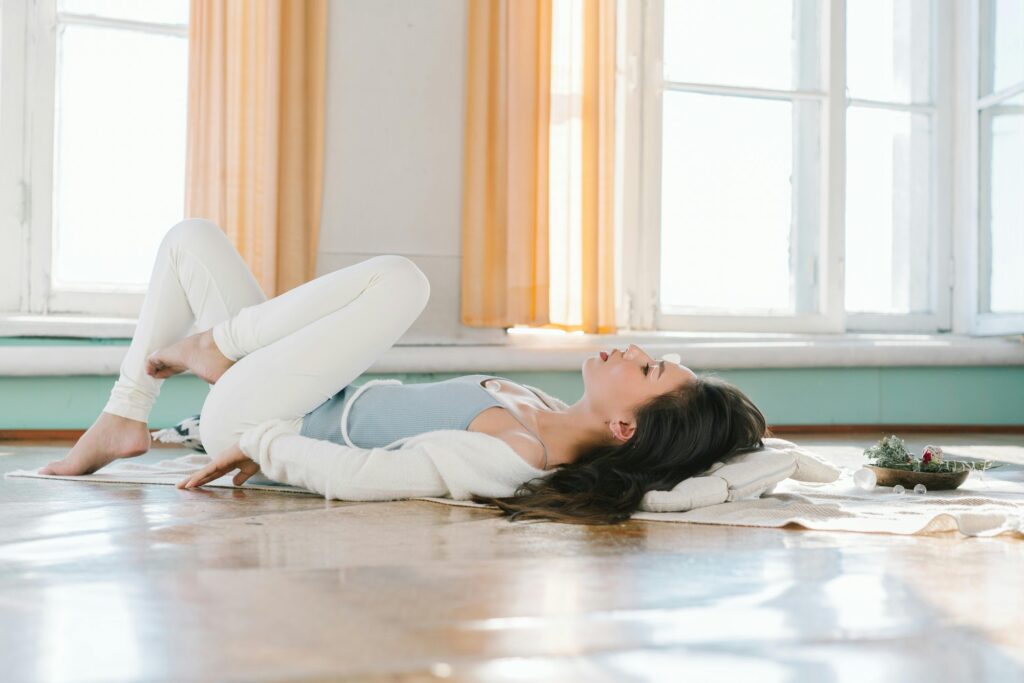
The first odd thing about progressive muscle relaxation is how deliberate it feels. You tense a hand, a shoulder, a thigh; then you let go and notice what changes. The method is simple enough to sound trivial, but the evidence suggests a narrower, useful role: it may help some adults practise downshifting stress, without replacing mental-health or medical care.
What the technique actually asks of the body
Progressive muscle relaxation, often shortened to PMR, is a structured contrast exercise. A person deliberately tenses one muscle group for a short period, releases it, and moves through other areas of the body in sequence. The point is not strength training. It is learning the sensory difference between tension and release.
The National Center for Complementary and Integrative Health describes progressive relaxation as a technique that involves tensing different muscles and then releasing the tension. It sits among other relaxation approaches, including guided imagery, biofeedback-assisted relaxation, self-hypnosis, and breathing exercises.
That family resemblance matters. PMR is not a treatment category in the way cognitive behavioural therapy or medication is. It is a self-administered skill that tries to create a relaxation response: slower breathing, lower heart rate, and a calmer physiological state. For some people, the muscle cue is easier to follow than a purely mental instruction to “relax”. For others, it may feel awkward or even unpleasant.
The evidence is promising, but uneven
The adult research base is stronger than a wellness anecdote, but less decisive than a clinical guideline. A 2024 systematic review in Psychology Research and Behavior Management examined progressive muscle relaxation for stress, anxiety, and depression in adults. The authors included randomised and quasi-experimental studies and concluded that PMR was associated with reductions in those outcomes.
That is useful, but the word “associated” is doing work. The studies varied by population, setting, length of practice, comparison group, and outcome measure. Some involved students, some clinical groups, and some people under specific stressors. A result from one setting should not be stretched into a promise for every anxious adult lying awake at 2 am.
A newer 2026 systematic review and meta-analysis in the Journal of Psychosomatic Research focused on sleep quality and mental-health outcomes in adults. It reported improvements in sleep quality, anxiety, and quality of life across randomised trials, but also flagged high heterogeneity. In plain English, the direction of the findings looked favourable, yet the trials were different enough that a single pooled estimate should be read cautiously.
Why muscle tension became part of stress science
Stress is not only a thought pattern. It is also a body state: faster breathing, higher alertness, tighter muscles, and, for some people, headache, jaw clenching, or shallow sleep. PMR takes that somatic piece seriously. Instead of arguing with worry, it gives attention a physical object.
NCCIH’s short guide on stress notes that the relaxation response is characterised by slower breathing, lower blood pressure, and a feeling of calm, and that relaxation techniques are often most useful when practised regularly and combined with broader health supports. That does not mean PMR “fixes” the nervous system. It means repeated practice may help some people recognise tension earlier and release it more deliberately.
This is where the language can become too grand. “Vagal tone” and “parasympathetic activation” are real physiological concepts, but most home PMR practice is not measuring them directly. A person may feel calmer, fall asleep more easily, or notice less shoulder tension. Those are meaningful experiences. They are not proof that a wearable score, immune marker, or cortisol pattern has been repaired.
Where it may fit in a week
The least dramatic use of PMR is probably the most credible one: a short, repeatable practice at a predictable time. That might be after work, before bed, during a lunch break, or after a difficult conversation. The technique does not need equipment, a subscription, or a special room. It does need enough attention that the person is not also driving, cooking, or supervising a child near a hazard.
Mayo Clinic’s patient guidance on relaxation techniques for stress management presents PMR as one option among several, alongside breathing, visualisation, meditation, yoga, tai chi, massage, music, and other approaches. That framing is sensible: PMR is a tool, not the tool.
It may pair especially well with ordinary stress hygiene. A person who practises PMR but sleeps five hours, drinks late caffeine, skips movement, and ignores an impossible workload may still feel strained. The practice can make the body quieter for a while. It cannot make an unsustainable life sustainable by itself.
Who should be more careful
Relaxation techniques are generally considered safe for healthy people, but “safe” is not the same as universally comfortable. NCCIH notes occasional reports of increased anxiety, intrusive thoughts, or fear of losing control during relaxation practice, and rare reports that some techniques might worsen symptoms in people with epilepsy, certain psychiatric conditions, or a history of abuse or trauma.
PMR also involves deliberate muscle contraction. Anyone with acute injury, severe pain, recent surgery, muscle spasm, uncontrolled blood pressure, or a clinician-imposed movement restriction should be cautious about tensing strongly. The safer version is gentle. It should not provoke pain, dizziness, panic, chest symptoms, or breath-holding.
Breathing often sneaks into PMR instructions, too. The American Heart Association advises people with heart or lung conditions to consult a health professional before trying deep-breathing techniques, and to stop if they feel dizzy or light-headed. That caution is relevant because many guided PMR recordings combine muscle release with slow breathing.
Persistent anxiety, depression, trauma symptoms, insomnia, chest pain, fainting, or panic attacks deserve proper assessment. PMR may sit beside care; it should not postpone care.
What this means in practice
- Try a short version first: five to ten minutes is enough to learn whether tensing and releasing feels calming or irritating.
- Keep contractions gentle, especially around the neck, jaw, back, abdomen, and any area with pain or injury.
- Practise at a regular low-stakes time before relying on it during acute stress.
- If guided breathing is included, avoid long breath holds and stop if you feel dizzy, light-headed, panicky, or short of breath.
- Use PMR as a support for stress regulation, not as a substitute for treatment for anxiety, depression, trauma, insomnia, or medical symptoms.
What we don’t know
The biggest gap is not whether PMR can make some people feel calmer. It can. The gap is how large the effect is for different people, how long it lasts, and which version works best. Trials often use different scripts, durations, teachers, and comparison groups, which makes the evidence hard to translate into a single prescription.
We also do not know enough about adverse experiences. Relaxation research tends to report benefits more carefully than discomfort, dissociation, intrusive memories, or panic-like responses. Those events may be uncommon, but they matter for the people who experience them.
Progressive muscle relaxation is best understood as a modest, practical body-based skill. It can teach some adults to notice and release tension. It cannot diagnose stress, repair a nervous system, or replace care when symptoms are severe, persistent, or medically concerning.
Photo: Mikhail Nilov on Pexels.