The Blue Zones story makes olive oil and nuts sound almost talismanic: eat like a Sardinian shepherd or an Ikaria grandmother and live longer. The evidence is more interesting, and less magical. Olive oil and nuts are consistently linked with better cardiovascular outcomes, especially inside a broader Mediterranean-style pattern, but they do not explain longevity on their own.
Blue Zones are a clue, not a controlled trial
Blue Zones entered the popular health vocabulary as places where unusually large numbers of people seemed to live into very old age. The food pattern that came with the story was appealingly simple: more plants, beans, olive oil, nuts, and whole foods; less processed meat and fewer ultra-processed snacks.
That does not make the Blue Zones a diet study. They are observations about populations, many of them small, with different histories, income patterns, medical access, food cultures, birth records, and social lives. Even where the age data are sound, the diet is only one part of the setting. Physical labour, walking terrain, family structure, smoking rates, infectious-disease history, and who survives long enough to be counted all matter.
So the sensible question is not whether olive oil and nuts are the secret of Blue Zones. It is whether these foods have evidence behind them when researchers look beyond the travel-poster version. On that point, the answer is cautiously yes. The strongest case is cardiovascular, not mystical longevity.
What olive oil seems to be replacing matters
Olive oil often gets talked about as if it has a single active ingredient. In real diets, it is also a replacement. A person who cooks vegetables in olive oil may be eating fewer butter-heavy sauces, fewer processed snacks, or less saturated fat. That substitution is part of the signal.
The American Heart Association describes a Mediterranean-style diet as one built around vegetables, fruits, whole grains, beans, nuts, seeds, olive oil as a primary fat source, and modest amounts of fish, poultry, dairy, and eggs. Its framing is useful because it treats olive oil as one piece of a dietary pattern, not as medicine in a bottle. The same guidance also stresses limits on added sugar, sodium, refined carbohydrates, and processed meats.
That distinction matters for readers who see a headline about olive oil and longevity and hear permission to add several tablespoons to an otherwise unchanged diet. The evidence is strongest when olive oil displaces less favourable fats and helps make plant-rich meals more satisfying. It is weaker when olive oil is simply added on top of excess calories.
The trial evidence is strongest for heart disease
The most cited clinical evidence comes from the republished PREDIMED trial in the New England Journal of Medicine, a Spanish trial of 7,447 adults at high cardiovascular risk but without cardiovascular disease at enrolment. Participants were assigned to a Mediterranean diet supplemented with extra-virgin olive oil, a Mediterranean diet supplemented with mixed nuts, or advice to reduce dietary fat. In the republished analysis, the olive-oil and nut groups had fewer major cardiovascular events than the control group over roughly five years.
That is meaningful, but it is not a proof that olive oil or nuts alone extend lifespan. PREDIMED tested a package: dietary counselling, a Mediterranean pattern, and either extra-virgin olive oil or nuts. The trial population was older and already at high cardiovascular risk, so the results may not apply cleanly to younger adults or people with different baseline diets. The trial also had protocol issues that led to republication, which is another reason to avoid turning it into folklore.
Still, if the question is whether olive oil and nuts can fit inside a heart-protective dietary pattern, PREDIMED is better evidence than most nutrition headlines can claim. It points toward a practical idea: the fat source in a diet matters, but so does the surrounding plate.
Observational studies support olive oil, with limits
Large cohort studies add another layer. A 2022 analysis in the Journal of the American College of Cardiology followed US health professionals and found that people with higher olive-oil intake had lower all-cause and cause-specific mortality than those who rarely or never consumed it. The researchers also modelled replacing margarine, butter, mayonnaise, and dairy fat with olive oil, and those substitutions were associated with lower mortality risk.
This is the kind of evidence that sounds stronger than it is. Cohort studies can adjust for many factors, but they cannot fully erase the fact that people who use olive oil may also have higher incomes, better access to healthcare, different exercise habits, or a generally healthier diet. Food-frequency questionnaires are also blunt instruments. Most people cannot accurately remember years of oil use.
But the pattern is consistent enough to take seriously. A 2022 systematic review and meta-analysis of prospective cohort studies also found olive-oil consumption associated with lower cardiovascular disease and all-cause mortality. The word is associated. It should stay associated. Nutrition research rarely gives us the clean causal certainty people want.
Nuts have a similarly steady, imperfect signal
Nuts are easier to parody because they are calorie-dense and often arrive salted, honey-roasted, or embedded in biscuits. The evidence is not about that version. It is mostly about plain tree nuts and peanuts eaten regularly in modest amounts within generally healthier diets.
A 2016 systematic review and meta-analysis in the British Journal of Nutrition found that higher nut consumption was associated with lower all-cause mortality, cardiovascular mortality, coronary heart disease, and coronary heart disease mortality across prospective cohort studies. The effect sizes were not a licence to eat unlimited nuts. They were a population-level signal that nuts can be part of a better dietary pattern.
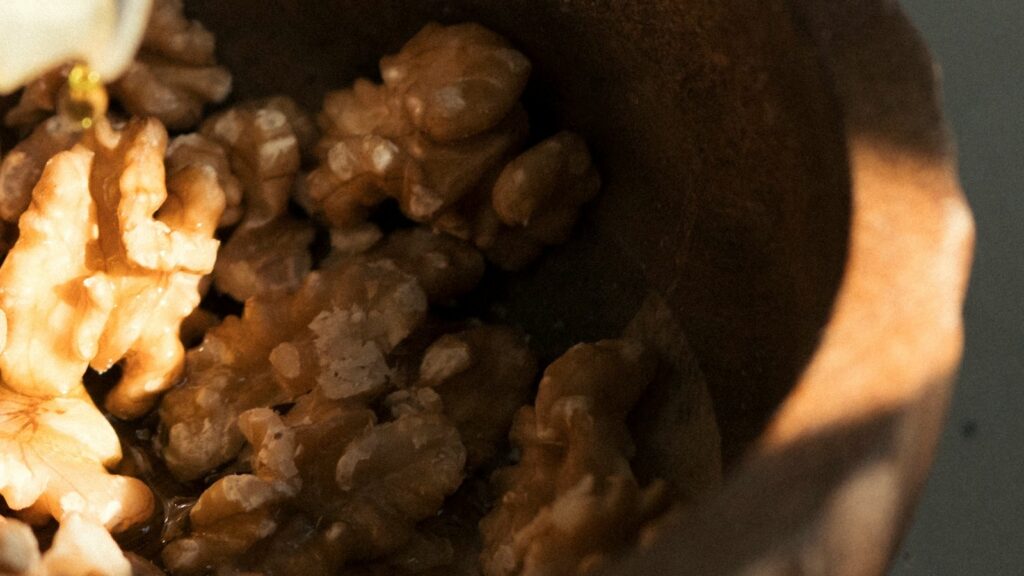
The plausible reasons are not exotic. Nuts provide unsaturated fats, fibre, plant protein, minerals, and polyphenols. They may improve lipid profiles or help replace refined snacks. But the same caution applies: a handful of walnuts after a plant-rich lunch is not the same intervention as a large packet of salted nuts alongside alcohol every evening.
The Mediterranean pattern is doing more than one job
The popular Blue Zones version often pulls out one food at a time. Olive oil gets a halo. Walnuts get a halo. Beans get a halo. That is how wellness marketing works, but it is not how diets work.
A Mediterranean-style pattern changes several things at once. It usually means more legumes, vegetables, fruit, whole grains, herbs, and fish; more unsaturated fat from olive oil and nuts; and less processed meat, refined grain, and confectionery. It may also mean eating meals rather than grazing through snack foods. Those shifts affect blood pressure, ApoB-containing lipoproteins, insulin resistance, inflammation, and body weight in different ways, and not all of them run through olive oil or nuts.
This is why the Blue Zones lesson, if there is one, is boring in the best sense. The repeatable part is not a remote island menu. It is a dietary default where plants are central, fats are mostly unsaturated, and the celebratory foods are not the everyday foods.
Where the health claims can become risky
Olive oil and nuts are foods, but they are not risk-free for everyone. Nuts are a major allergen. People with nut allergy should not experiment with them because of a longevity headline. Whole nuts can also be a choking risk for young children and for some people with swallowing difficulties.
Calories are another practical issue. Olive oil and nuts are energy-dense. For someone trying to manage weight, type 2 diabetes, fatty liver disease, or reflux symptoms, simply adding more fat may not be helpful. A dietitian can help with substitutions, portions, and meal structure, especially where there are medical conditions or medicines involved.
There is also the salt problem. Many commercial nut products are heavily salted, and high sodium intake is a concern for blood pressure. The heart-health evidence for nuts does not make salted snack foods a free pass.
What this means in practice
- Think substitution first: use olive oil in place of butter, creamy dressings, or less favourable fats, rather than adding it without changing anything else.
- Keep nuts modest: a small handful of unsalted nuts is closer to the evidence base than large snack portions.
- Use olive oil to make vegetables, beans, and whole grains easier to eat regularly.
- Choose mostly plain nuts; sweetened, chocolate-coated, and heavily salted versions are different foods nutritionally.
- If you have nut allergy, swallowing problems, complex metabolic disease, or a medically prescribed diet, get individual advice rather than following generic longevity claims.
What we don’t know
We do not know whether olive oil or nuts meaningfully extend human lifespan independent of the wider diet and lifestyle around them. We do not know the ideal dose for every population, and it is unlikely that one exists. We also do not know how much of the Blue Zones story reflects diet, age validation, social structure, physical activity, genetics, healthcare access, or survivorship.
The evidence is good enough to treat olive oil and nuts as useful parts of a Mediterranean-style diet. It is not good enough to treat them as longevity insurance. The honest version is less glamorous: swap better fats for worse ones, make plants easier to eat, and leave the miracle language to people selling miracles.
Photo: Ahmet Koc on Unsplash.