Strength training gets most of the attention in midlife fitness, and deservedly so. But for everyday ageing, the missing quality is often speed: how quickly the legs can stand you up, catch a stumble, or climb the last few stairs. Power training is one way to train that quality, though the evidence supports caution rather than bravado.
Power is not just strength with a louder name
Muscle strength is the ability to produce force. Muscle power is force produced quickly. The distinction matters because many ordinary tasks are timed by life, not by the gym. Rising from a low chair, crossing a road, recovering from a trip, and carrying shopping upstairs all ask for enough force delivered fast enough.
A 2022 systematic review and meta-analysis in the European Review of Aging and Physical Activity framed the issue plainly: muscle power may be a more critical determinant of physical function in older adults than strength alone. In the review, power training outperformed traditional strength training on muscle-power outcomes and several activity-based tests, although the trials were small and varied in design.
That does not make power work a replacement for ordinary resistance training. It makes it a possible next layer. If someone cannot squat to a chair, step up safely, or control a slow lowering phase, moving faster is premature. Speed is useful only when it sits on top of control.
Why ageing changes the speed problem
Ageing does not remove the need for quick movement. It makes quick movement more expensive. Nerve signalling, muscle fibre composition, tendon stiffness, joint confidence, pain, and balance all influence how decisively a person can move. The result is not simply weaker muscles, but a narrower margin for reacting when the environment changes.
This is why the same review noted that tests such as chair rise, walking speed, timed up-and-go, stair climbing, and floor-rise tasks are common outcomes in power-training studies. They are not vanity measures. They resemble the physical moments that decide whether an older adult feels capable in daily life.
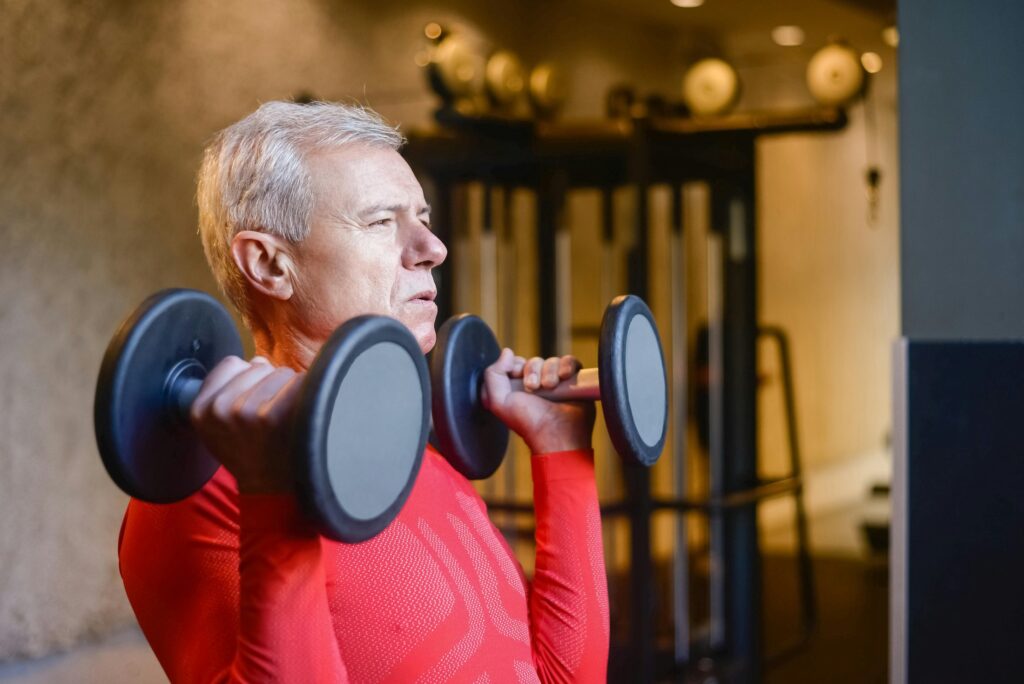
The practical point is modest: once basic strength and technique are established, some movements may benefit from an intentional fast lifting phase and a controlled lowering phase. That could mean standing briskly from a chair, pressing a light weight with intent, or stepping up with a little more decisiveness. It does not mean jumping into explosive barbell lifts.
What the evidence actually supports
The case for power training is credible, but not settled. The 2022 meta-analysis included 15 trials and 583 participants. It found statistically significant advantages for power training over strength training for muscle power and some functional tests. But the authors also reported heterogeneity, limited standardisation, and no included studies that measured physical activity levels in daily life.
That last gap is important. A faster chair-rise test in a clinic is useful, but it is not the same as proving that someone walks more, falls less, or stays independent for longer. The evidence is strongest for improving measured performance. The longevity claim is indirect.
Still, the direction is consistent with broader exercise guidance. The American College of Sports Medicine’s practical guidance for older adults notes that strength work can use heavier loads for strength or lighter loads for power, and that balance and functional exercises can sit alongside resistance work. The key word is alongside. Power training is not a separate identity; it is a way of organising effort inside a rounded programme.
Falls prevention is a related, not identical, claim
It is tempting to say power training prevents falls. That is too neat. Falls are caused by many interacting factors: vision, medication effects, footwear, blood pressure changes, home hazards, vestibular problems, neurological disease, fear, and previous falls, as well as strength and balance.
What can be said more carefully is that exercise has a meaningful role in falls prevention for some older adults. The 2024 US Preventive Services Task Force recommendation concluded with moderate certainty that exercise interventions provide a moderate net benefit for community-dwelling adults aged 65 or older who are at increased risk of falls.
That recommendation is broader than power training. It does not say that fast lifting is the necessary ingredient. It supports exercise interventions, often including balance, strength, gait, and functional training. For a reader, that distinction matters. Power work may be useful; it is not a stand-alone falls-prevention plan.
Where speed belongs in a cautious session
A safe power session does not have to look dramatic. For many adults over 50, the useful version is low-skill, repeatable, and easy to stop if form changes. The movement is brisk on the lifting phase, controlled on the return, and never rushed through pain or loss of balance.
The CDC guidance for adults aged 65 and older recommends a weekly mix of aerobic activity, muscle-strengthening activity, and balance work, with the caveat that people should be as active as their abilities and conditions allow. That caveat is not small print. It is the difference between useful training and a programme that ignores the person in front of it.
In practice, power can be introduced by changing intent before changing complexity. A chair stand can become a power exercise when the upward phase is purposeful and the descent stays slow. A step-up can be powerful without being high. A resistance-band row can be brisk without being jerky. The aim is speed under control, not speed instead of control.
Who should be more careful
Medical caution belongs near the top, not in a footnote. Adults with unstable heart symptoms, unexplained chest pain, fainting, severe breathlessness, uncontrolled blood pressure, recent surgery, significant osteoporosis, acute joint injury, neurological symptoms, or a recent fall should get individual clinical advice before adding fast resistance work.
Medication can matter too. Sedatives, some blood-pressure medicines, glucose-lowering drugs, and drugs that affect balance or alertness may change the risk of a session. Pain is also information. Sharp, new, radiating, or worsening pain is not a signal to push through.
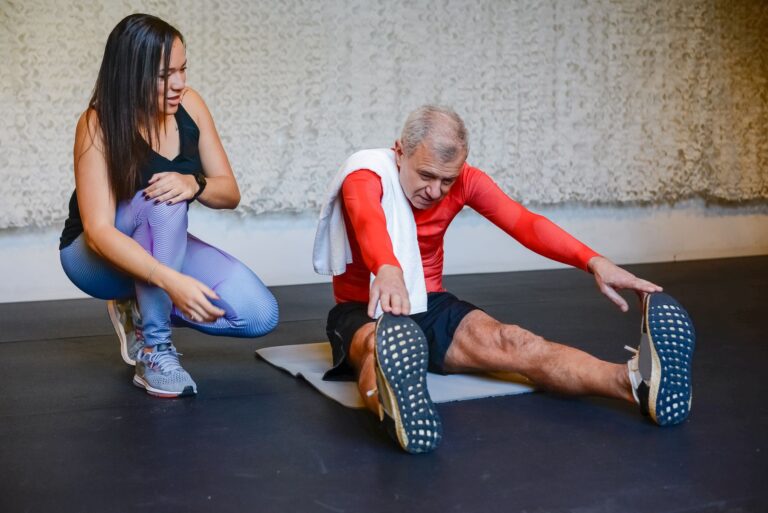
The more deconditioned someone is, the less impressive the exercise needs to look. A supervised physiotherapist, clinical exercise physiologist, or qualified trainer with older-adult experience can help select movements that are challenging without being reckless.
What this means in practice
- Build ordinary strength first: chair stands, step-ups, rows, presses, and carries are useful starting points when they can be done with control.
- Add speed only to the lifting phase: move up or out with intent, then return slowly enough to stay balanced.
- Choose low-skill movements before explosive ones: bands, machines, light dumbbells, and chair-based work are often easier to control than jumps or Olympic-style lifts.
- Keep balance in the programme: power work should sit beside walking, balance practice, mobility, and progressive resistance training.
- Stop for red flags: chest pain, dizziness, faintness, unusual breathlessness, sharp pain, or new neurological symptoms warrant stopping and seeking medical advice.
- Progress by quality before load: a cleaner, quicker chair stand is a better sign than adding weight while technique deteriorates.
What we don’t know
The evidence does not yet tell us the best power-training prescription for most adults over 50. Studies vary in exercises, loads, supervision, duration, and participant health. Many trials are short. Few show whether improvements in test performance translate into fewer falls, longer independence, or better long-term health outcomes.
There is also a selection problem. People who enrol in exercise trials are often healthier, more motivated, and more supervised than the average person reading an article at home. That does not make the findings useless, but it should lower our confidence in broad claims.
The most defensible conclusion is therefore conservative. Power training may be a valuable addition once someone has a base of strength, balance, and movement confidence. It is not a cure for ageing, and it is not a dare. The useful version looks almost ordinary: controlled movements, performed with a little more intent, and scaled to the body doing them.
Photo: Kampus Production on Pexels.