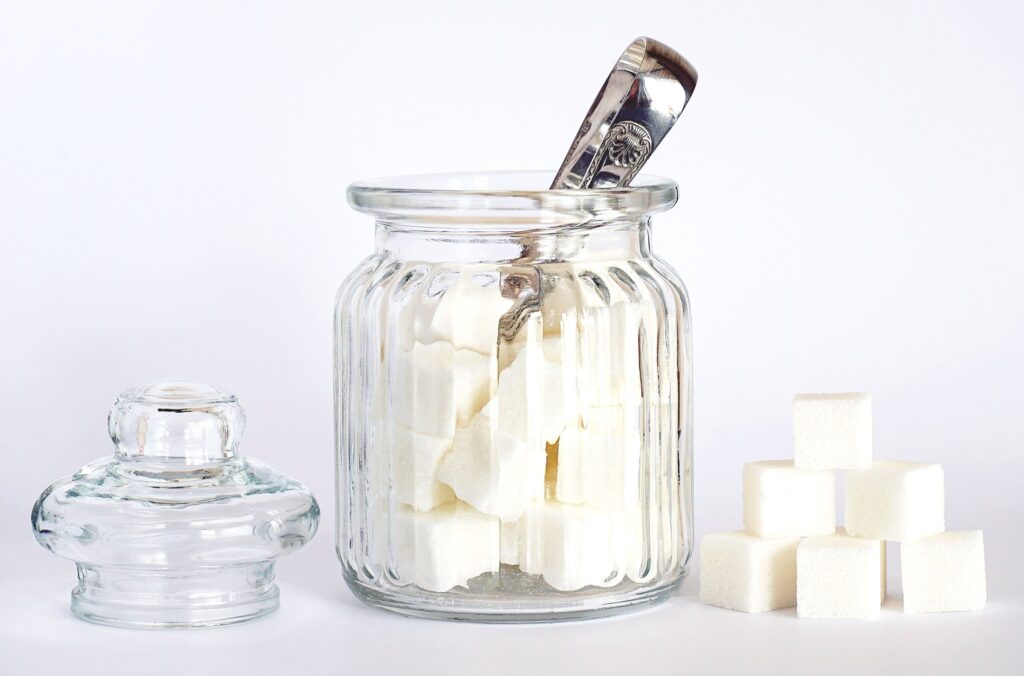
Sugar substitutes sit in an awkward place in nutrition. They can help someone cut sugar from a daily fizzy drink or coffee habit. They can also become a health halo for ultra-processed foods that still do little for appetite, diet quality, or metabolic health. The evidence is not a clean yes or no. It is a question of what is being replaced, how often, and for whom.
Why the easy answer keeps failing
The popular claim is simple: swap sugar for a zero-calorie sweetener and weight should fall. In tightly controlled settings, that can happen, especially when the substitute replaces a meaningful amount of sugar rather than being added on top of the usual diet. But everyday eating is less tidy. People compensate, labels confuse, and “sugar-free” can make a biscuit or dessert seem more virtuous than it is.
This is why the 2023 World Health Organization guideline on non-sugar sweeteners recommended against using them as a long-term strategy for weight control or lowering chronic disease risk. That recommendation was not a claim that every sweetener is acutely dangerous. It was a judgement that, across the evidence, long-term health benefits were not convincing enough to make non-sugar sweeteners a population-level weight-loss tool.
That distinction matters. A person replacing six cans of sugary cola a day with diet cola may reduce sugar intake substantially. A person adding sweetener tablets to an otherwise balanced diet may see no measurable benefit. A person buying more “no added sugar” snacks may move in the wrong direction without noticing.
Short-term calorie savings are real, but narrow
The strongest argument for sugar substitutes is substitution. Sugar brings energy without much satiety. If a sweetener removes sugar from tea, coffee, yoghurt, or a soft drink, it can lower total energy intake without requiring a dramatic change in taste. That is useful, particularly for people who are trying to reduce sugar-sweetened drinks gradually.
The weakness is that calorie arithmetic does not always survive contact with real life. Some trials show modest benefits when sweeteners replace sugar under controlled conditions; observational studies often find that heavier sweetener users have higher cardiometabolic risk. That does not prove the sweeteners caused the risk. People at higher risk of weight gain, type 2 diabetes, or cardiovascular disease may be more likely to choose diet products in the first place.
So the practical question is not “are sweeteners fattening?” It is “does this specific swap reduce sugar without increasing appetite, snacking, or reliance on ultra-processed foods?” If the answer is yes, the swap may be sensible. If the answer is no, the label has done more work than the food.
The heart-health signal is unsettled
Several large cohort studies have raised concerns about artificial sweeteners and cardiovascular outcomes. In the French NutriNet-Sante cohort, a 2022 study in The BMJ reported that higher artificial sweetener intake was associated with increased cardiovascular disease risk. Aspartame, acesulfame potassium, and sucralose were all part of the analysis.
That finding should not be inflated into certainty. Cohort studies are excellent for detecting patterns, but they struggle to prove cause and effect. Diet products are often chosen by people already worried about weight, blood sugar, or heart health. Researchers adjust for many of those differences, but adjustment is never perfect.
Still, the signal is enough to puncture the idea that sweeteners are automatically neutral. For someone with high cardiometabolic risk, a daily diet-drink habit is not the same as water, unsweetened tea, or coffee. It may be better than several sugary drinks; it is not a free pass.
Gut and glucose responses may differ by person
The gut microbiome has become a convenient explanation for almost everything in nutrition, which should make us cautious. But sweeteners may be one area where individual responses are genuinely relevant. In a 2022 human trial published in Cell, researchers found that several non-nutritive sweeteners produced person-specific effects on glucose tolerance and microbiome composition.
The important word is “person-specific”. The study did not show that every sweetener disrupts everyone’s blood sugar. It suggested that some people may respond differently, and that the microbiome may be part of the explanation. That is interesting science. It is not yet a practical test you can buy with confidence, nor a reason to panic about one sweetened coffee.
For now, the plainest advice is observational: if a sweetener seems to increase cravings, digestive discomfort, or snacking for you, that is useful information. If it helps you move away from a high-sugar drink without any obvious downside, that is useful too.
Dental health is the clearer win
One place sugar substitutes do look more straightforward is teeth. Oral bacteria ferment sugar and produce acids that contribute to decay. Replacing sugar with non-fermentable sweeteners removes that substrate. Sugar-free chewing gum may also stimulate saliva, which helps buffer acids after meals.
The evidence is not perfect, but it is more practically coherent than the weight-loss story. A systematic review and meta-analysis on sugar-free chewing gum and dental caries found tentative evidence that sugar-free gum reduced caries increment compared with no chewing controls. The authors still called for better studies, which is the right level of caution.
This is where “sugar-free” can mean something concrete. Sugar-free gum after lunch is a different proposition from a sweetener-heavy dessert marketed as healthy. Same broad category, very different use.
Natural does not mean metabolically special
Stevia and monk fruit are often sold with a cleaner image than aspartame or sucralose. That may matter for taste preference, but “plant-derived” is not a health outcome. A purified steviol glycoside is still a high-intensity sweetener. It should be judged by evidence, dose, and use, not by whether the marketing sounds closer to a garden.
Sugar alcohols such as xylitol, sorbitol, and erythritol are another category again. They provide fewer calories than sugar and are commonly used in gum, sweets, and low-sugar products. NHS guidance on sweeteners notes that polyols such as sorbitol, xylitol, and erythritol can have a laxative effect when consumed in large amounts. For many people, the limiting factor is not metabolic theory but gut tolerance.
The simplest rule is to read the whole food, not just the sweetener claim. A yoghurt with less added sugar and more protein may be useful. A packet of biscuits with a different sweetener and the same snack pattern probably changes less than the label implies.
What this means in practice
- Use sweeteners mainly as a bridge away from high-sugar drinks, not as proof that a product is healthy.
- Compare the whole label: fibre, protein, ingredients, and portion size matter more than “sugar-free” on its own.
- If you drink several diet drinks a day, try replacing one with water, sparkling water, unsweetened tea, or coffee.
- For dental health, sugar-free gum after meals is a more defensible use than sugar-free sweets eaten frequently.
- If sugar alcohols upset your gut, reduce the dose rather than searching for a more exotic version.
- For children, keep the goal as a less-sweet palate overall, not a permanent rotation of sweetened substitutes.
What we don’t know
We do not yet know whether long-term, habitual use of specific sweeteners has different health effects in different groups of people. We also do not have enough head-to-head evidence to say that one common sweetener is clearly best for weight, heart health, glucose control, or the microbiome.
The biggest uncertainty is behavioural. A sweetener can be a useful swap if it reduces sugar exposure. It can be a distraction if it keeps the diet centred on sweet foods and drinks. Most studies cannot fully capture that difference because the context of eating is hard to measure.
So the sensible position is neither fear nor enthusiasm. Sugar substitutes can be useful tools, especially for reducing sugar-sweetened drinks and protecting teeth. They are not a health shortcut, and they do not turn a weak diet into a strong one.
Photo: Suzy Hazelwood on Pexels.