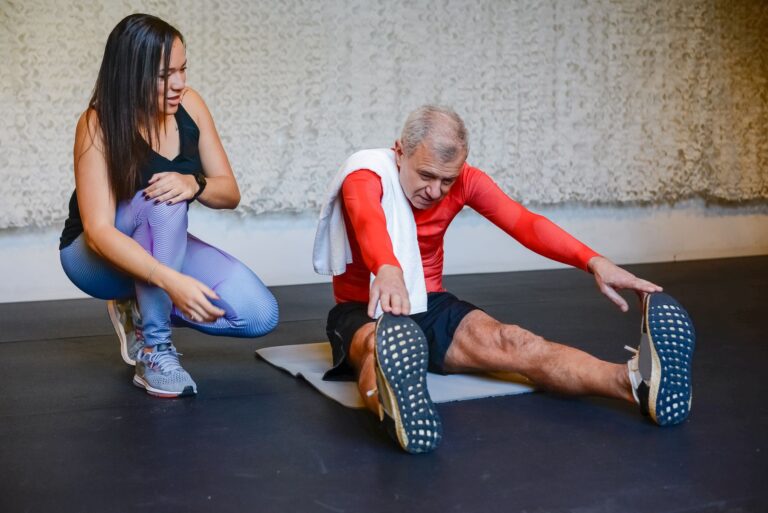
Many programmes for people over 50 fail for a very ordinary reason: they are built like a performance test, not a life routine. The evidence is clear that strength and balance improve function, but most of the disappointing outcomes come from doing too much too soon or recovering as if your body were still twenty-five. The winning formula is usually boring: a smaller total load, done consistently, with recovery treated as a training variable.
Why every over-50 training plan breaks the same way
The first trap is velocity. People often start from a calendar, not from their current stress load. Workouts escalate, sleep stays erratic, stress rises, and soreness accumulates. When that happens, the body starts to tax adaptation through temporary plateaus that look like “bad luck” rather than overreach.
That is why guidance remains useful: the same effort signal that creates a meaningful stimulus at 30 does not always convert to sustainable progress at 60. This is not a weakness argument, it is an adaptation argument. A recovery-aware approach has stronger evidence for preserving adherence and function over time than hero-session intensity.
What guidelines actually emphasise in practical terms
Public-health guidance has already put movement on a simple scaffold. The WHO and CDC both describe minimum activity targets for older adults and separate guidance around strengthening and balance work, recognising that routine endurance alone is not a complete solution for function and fall risk. WHO physical-activity guideline and CDC older-adult activity guidance both leave little room for interpretation on this point.
In UK guidance, the recommendation is not only “move more”, but structure movement as specific capability work. NICE’s falls guidance for older people aligns with that logic: combine strength and balance in programmes for people who are increasing risk as they age, rather than treating these elements as optional extras. NICE NG249
Balance and strength are not alternatives — they are a pair
Exercise science has been consistent here for years: strength training protects against deconditioning and functional decline, while balance training reduces the impact of instability under fatigue and real-world perturbation. A broad review of balance-focused interventions in older adults has shown moderate confidence in fall-related benefit when programmes combine these elements with consistency and adherence.
Cochrane review of community-based fall prevention exercises underpins that direction.
For someone over 50, this usually means a week that does not over-index on one mode. If you only lift heavier or only do long walks, you may improve one system and leave another system as the limiting factor. Then the programme feels “hard” but not clearly life-improving, which is how adherence gets abandoned.
What the resistance literature says about dose, and how to interpret it
Systematic work on older adults with reduced lean mass repeatedly points to the same pattern: moderate resistance appears to be enough for meaningful effect if progression is structured and repeated. The best outcomes come from weekly consistency, clear load progression, and careful response monitoring rather than maximal daily effort. A 2023 review of resistance programmes for older adults with sarcopenia concluded that dose, frequency, and progression design can matter as much as exercise selection. PubMed review: resistance training and sarcopenia
Translated: if you improve slowly but steadily, you may outpace a more chaotic but noisier programme over months. That is the adaptation paradox for older adults. The nervous system and musculoskeletal system respond well to stimulus, but only if the stimulus is repeatable week by week.
Where recovery changes the equation
Recovery is often spoken about as “rest days”, but it is more than absence of exercise. For this age group, recovery is:
- Sleep quality and duration, especially the continuity of nocturnal rest.
- Session spacing and load order.
- Progressive hydration and protein timing around workouts.
- Symptom-aware tapering rather than rigid programming.
These are not lifestyle add-ons. They are variables that determine whether training translates into function. If the same workout causes persistent fatigue, sleep-onset delay, or joint pain for repeated days, the programme is probably too much, too soon.
A practical 4-day pattern for over-50 training
The following template is not a fixed prescription. It is a scaffold:
- Session 1: full-body strength A (lower-body hinge + upper pushing/pulling), RPE 6–7, 2–3 sets.
- Session 2: balance and mobility block (5–12 minutes of controlled unilateral stance, step transitions, loaded carries).
- Session 3: full-body strength B, focus on a different pattern (squat, hinge, push, pull, carry), with the same progression frame.
- Session 4: low-impact zone 2 conditioning (walk, cycle, row) for 20–30 minutes.
Start with 2–3 days between strength sessions, and treat the fourth day as either additional aerobic stimulus or an easier recovery-oriented walk. In people over 55 who are coming from low activity, this is often better than four hard sessions with collapsing quality.
Progression rule: add a small amount of load or range only when weekly symptom and performance markers are stable. A useful objective is this: if soreness is not settling, if sleep is drifting and unstable, or if step quality declines under fatigue, hold progression for one week.
Why a deload is strategy, not failure
Deload weeks are usually framed as weakness in online culture. In practice they are a performance tool. Three hard weeks followed by one deliberately easier week keeps adherence honest and reduces non-specific fatigue. In movement terms, this gives connective tissue and the nervous system a chance to absorb the load.
For anyone with recurring knee, hip, or back pain, an explicit deload is often the point at which programmes become sustainable rather than temporary. The goal is not to avoid discomfort entirely. The goal is to avoid the compounding discomfort that silently drains confidence and consistency.
What this means in practice
- Choose 2 dedicated strength sessions and 1 balance-mobility session as a non-negotiable weekly minimum.
- Use progressive overload by tiny steps, not giant jumps: +1–2.5 kg, +1–2 extra reps, or a small ROM increase.
- Place at least 48 hours between heavy sessions and assess recovery markers before increasing load.
- Include easy zone-2 work to support blood flow and recovery rather than replacing strength with long, high-intensity efforts.
- Keep a simple weekly log with sleep, step quality, and pain/energy scores before each session.
- Treat one week per month as a deload week if performance markers are flat or pain is drifting upward.
What we don’t know
We still do not have robust, one-size-fits-all progression data for every age band above 50, nor perfect evidence on whether one named protocol dominates for people with multiple chronic conditions. The literature is still limited by protocol heterogeneity: different programmes, different populations, different adherence windows. We also lack a universal load-response model that predicts who should progress faster or slower from the first week.
So while the direction is stable, the fine print is not. If you are over 50, the highest-yield strategy is still practical: prioritise consistency, include strength and balance, and use recovery as part of the training plan rather than the plan’s neglected afterthought.
The same applies across body shapes, jobs and training histories. For movement that must last decades, “good enough today, repeated next week” often beats “heroic today, exhausted for two weeks.”
That extra stability is not glamorous. The winning plans for many people in their fifties are the ones with an easy return on fatigue: three simple sessions, a short walking block, and one clear recovery check before the next increase. If you can run that at 9 p.m. after a bad day, your routine will survive the real world.